VHF Radio Etiquette: The Calls That Mark You as a Pro
What professional radio sounds like, and what makes you sound like an amateur.
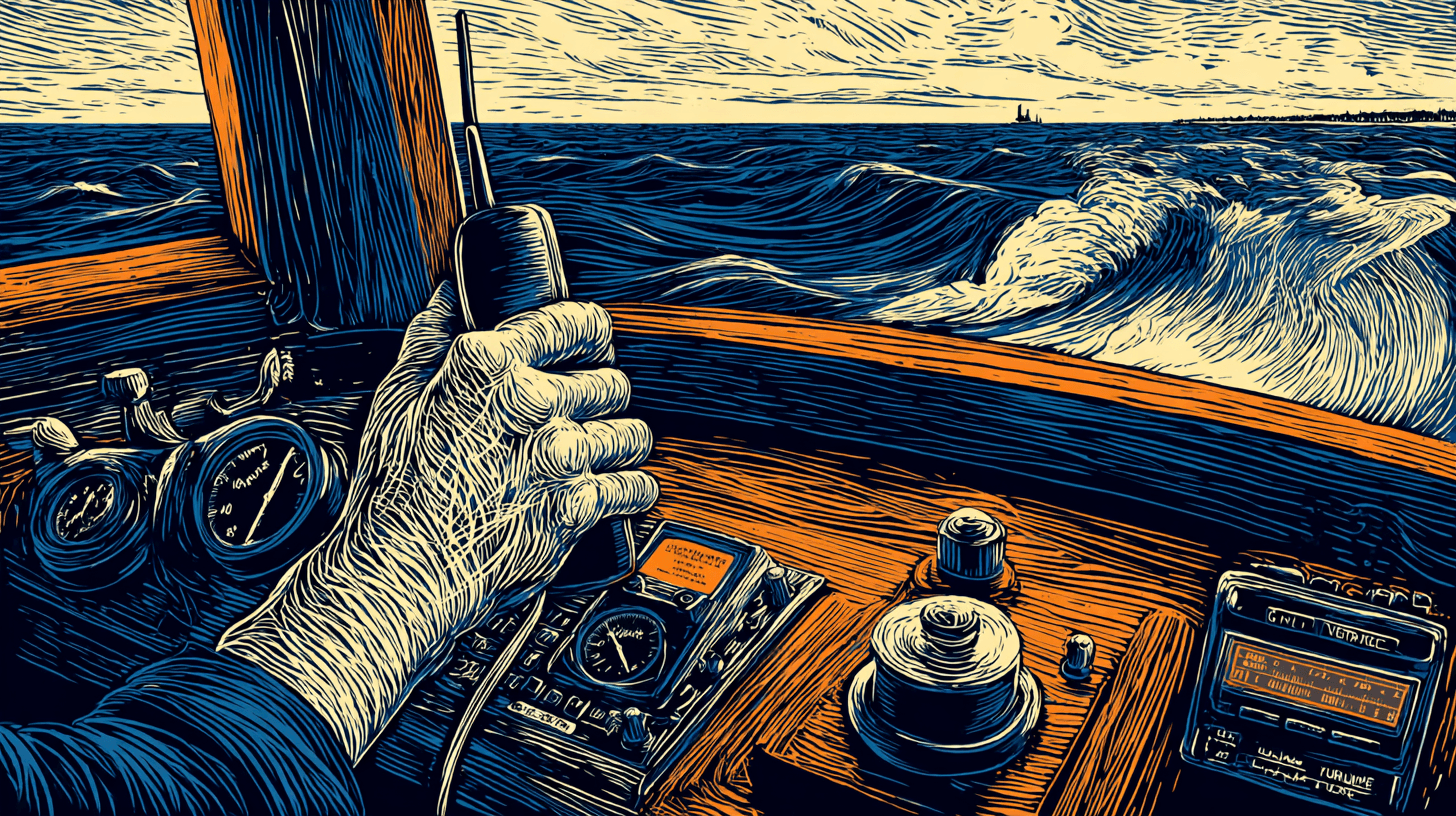
Stand on a marina dock anywhere in SE Michigan on a busy summer Saturday and listen to Channel 16 for ten minutes. You'll hear three kinds of boaters.
The first kind doesn't use the radio at all. They got through the safe-boating course years ago, never went back to it, and treat the VHF as a piece of safety equipment that lives mounted to the helm. It works in theory. They've never tested it.
The second kind uses it constantly, and badly. They call vessels they can see by name on the side. They chat. They argue with the bridge tender. They forget to switch off 16 to a working channel. Half the boats in the marina hear every word, and most of those boats wish they hadn't.
The third kind makes you stop and listen. They sound like commercial mariners — not because they're trying to, but because they know what radio is for. They make their calls short, clear, and on the right channel. They handle bridge openings without theatrics. When they're done, they sign off and disappear from the airwaves. You hear them once and you remember it.
This is the article on how to be the third kind.
Why VHF still matters in 2026
Phones don't get you a bridge opening. AIS doesn't tell the freighter you're going to give them the deep water. Your group text doesn't reach the Coast Guard in a distress.
VHF marine radio is the only system that does all three. It reaches everyone within roughly ten miles on Channel 16. The Coast Guard monitors it twenty-four hours a day. Commercial traffic monitors it constantly. And it works regardless of whether the cell tower is in range.
The other reason it matters: it's how marine professionals communicate. The way you handle the radio is how the other boats around you — and the bridge tenders, and the dock hands at the next marina, and the captain of the freighter you're about to meet at a bend in the river — form their first impression of who's running your boat. That impression shows up in how they respond to you. Good radio gets you better cooperation. Bad radio doesn't.
Channel 16: what it is, and what it isn't
Channel 16 is a calling and distress channel. Not a chat channel. Not a working channel. Not a place to argue with the boat that just cut you off.
The way it's supposed to work: you make contact on 16, you and the other party agree on a working channel, and you both switch over. The actual conversation happens on the working channel — typically 68, 69, 71, or 72 on the recreational side. When you're done, you sign off and Channel 16 goes back to being available for the next person who needs it.
The owners who use 16 like a chat channel aren't doing anything illegal — but they are clogging the one frequency that everyone on the water depends on for safety calls. It's the marine equivalent of using the emergency line for conversation.
If your radio has DSC — digital selective calling, available on most modern VHF units — learn to use it. DSC lets you call a specific vessel directly using their MMSI number, the same way you'd dial a phone, without putting anything on 16 at all. Most boaters who have DSC never set it up. It's worth the twenty minutes.
The shape of a proper call
A clean VHF call has a structure. Once you know it, you can run any call in about fifteen seconds.
You start by saying the receiving vessel's name three times, then your vessel's name once, then "over." Saying the receiving name three times sounds excessive until you're listening on a marina full of overlapping radio traffic — then you understand why the convention exists. The third time is when the other party realizes you're calling them.
You wait for a response. When it comes, you propose a working channel: "Switch and answer six-eight, over." The other party confirms, you both switch off 16, and the actual exchange happens there. Three or four sentences max in most cases.
When the exchange is finished, you sign off with your vessel name and "out." Not "over and out" — that's a movie convention that means contradictory things. Just "out." Then you switch back to 16 and resume monitoring.
That's the whole structure. Once it's habit, you'll do it without thinking about it.
Bridge openings: where most owners go wrong
Lake St. Clair, the Detroit River, and the connecting waterways have a half-dozen drawbridges between them. Some open on schedule. Some open on request. Some require an hour's notice. All of them have a VHF protocol, and the protocol matters because the bridge tender is making a decision about whether to interrupt road traffic for your vessel.
The standard call: "[Bridge name], [bridge name], this is [vessel name] approaching from [direction], requesting an opening, over."
That's it. Don't add color commentary. Don't explain why you need to get through. Don't argue if the tender says wait. The tender will respond with timing — "I can open at the next interval" or "Stand by, I have road traffic" — and you say "Roger, standing by," and you stand by.
The boats that don't get prompt openings are usually the ones whose captains argue with the bridge tender. The tender is doing a job, has heard every version of the argument, and isn't motivated to do you favors. The boats that get the smoothest treatment are the ones whose captains make the request once, accept the answer, and don't crowd the bridge while waiting.
Specific to our waters: each of the bridges on Lake St. Clair, the Detroit River, and the St. Clair River has its own monitoring channel and convention. Local knowledge matters. If you're new to these waters, look up the bridge protocols before you transit them the first time.
Commercial traffic on the Detroit River and Lake Huron
If you cruise the Detroit River, the St. Clair River, or the open water of Lake Huron, you're sharing it with commercial freighters and tugs. The channel they use to coordinate with each other and with smaller craft is 13 — the bridge-to-bridge channel for ship-to-ship navigation in U.S. waters.
When a freighter is approaching a bend or a narrow section, the captain may call out on 13 to coordinate passing arrangements with any vessel ahead or behind. If you're in the area, you should be monitoring 13 in addition to 16. If they call you, the standard recreational response is simple: "[Freighter name], this is [your vessel name]. I'll give you the deep water and pass on the [one whistle / two whistle] side, over."
One whistle means a port-to-port passing. Two whistles is starboard-to-starboard. The "whistle" terminology is commercial-mariner vocabulary that recreational boaters often don't know — but using it correctly tells the freighter captain that you understand the convention and you're going to do what you said you'd do. That's worth a lot more than another nervous call asking what they want you to do.
Distress, urgency, and safety
Three calls every captain should know, in descending order of severity.
Mayday. Grave and imminent danger to vessel or person. Sinking, fire, life-threatening medical emergency. Repeated three times, followed by your vessel name three times, your position, the nature of the emergency, and what assistance you need. Coast Guard takes priority over everything else on the airwaves when a Mayday is called.
Pan-Pan (pronounced "pahn-pahn"). Urgent message, not immediately life-threatening. Disabled vessel in a hazardous location. Person overboard who has been recovered but needs medical assistance. Used to alert other vessels and the Coast Guard without invoking full distress protocol.
Securité (pronounced "say-cure-ee-tay"). Safety message, no immediate emergency. Hazard to navigation announcement. Debris in the channel. Drifting log. Used to inform other vessels of a hazard they need to know about.
These three calls exist for a reason and are taken seriously. Don't use them casually, but don't hesitate to use them when conditions warrant. Mariners universally respect a properly made distress or safety call.
What marks a professional
Watch a working captain handle the radio for an hour and you'll see the same patterns.
Calls are short. Two or three sentences, usually under fifteen seconds. The professional doesn't fill airtime — they make the call, get the answer, sign off.
Channel discipline is automatic. They switch to working channels without being reminded. They monitor 13 in commercial waters. They use the phonetic alphabet for vessel names with unusual spelling — "Whiskey Alpha Tango Charlie Hotel" for a boat named Watch — because the alternative is repeating it five times.
They don't editorialize on the airwaves. The other boat's mistake, the bridge tender's slow response, the inconvenience of the situation — none of it makes the radio. The professional fixes problems off the air, not on it.
And they know when not to transmit at all. If the call doesn't need to be made, they don't make it. If the situation will resolve itself in thirty seconds, they wait thirty seconds. The radio is for communication that has to happen — not for communication that fills space.
VHF operation is one of the named skills in the First Mate Coaching program for exactly this reason. A first mate fluent in radio protocol is a first mate who can call the bridge while the captain handles the helm, coordinate a passing while the captain navigates a current, or run a distress call if the captain is the one who's down. Worth the time it takes to learn.
Closing
You don't sound like a pro on the radio by trying to sound like one. You sound like a pro by making short, clear calls on the right channels and not filling the air with anything else. The boats around you will notice. The bridge tenders and the freighter captains will respond differently. The next marina you arrive at will treat you like the captain you sound like on the way in.
If you're looking to build out the radio side of how you and your first mate work the boat, the conversation starts here.