What Lake St. Clair Asks of Boat Owners
It looks like the friendliest water in the region, and most days it is. The trouble is what eleven feet of average depth does when the wind comes up.

Captain Tom Ketelhut
Lake St. Clair gets dismissed a lot. It's the small one. The puddle between the big lakes. People run Lake Huron and Lake Erie and treat St. Clair as the thing they cross to get from one to the other.
That's a mistake, and it's usually the people who underestimate it who end up having a bad afternoon out there.
The lake doesn't ask much of you on a calm day. Most days are calm days. But the things that make it forgiving most of the time are the same things that make it bite hard when conditions turn, and the boaters who get caught are almost always the ones who read "small and shallow" as "safe" instead of "different." Here's what the lake actually asks of you.
It Asks You to Respect Eleven Feet of Water
Lake St. Clair averages about 11 feet deep across its whole 430 square miles, with a maximum natural depth of only around 23 feet, according to the data the U.S. Army Corps of Engineers works from. That's a wide, flat, shallow pan of water.
Shallow water has one defining behavior: it builds a steep, short, ugly chop fast. A lake this shallow responds to wind almost immediately, and waves can stack to three and four feet in a strong blow even though the fetch is short. On a deep lake the wind needs time and distance to build a sea. On St. Clair it doesn't. The wave period is short and the faces are steep, so instead of the long rolling swell you get out on Huron, you get a tight, hammering chop that beats a boat and a crew up in a hurry.
It also lays back down fast once the wind drops, which is the part that fools people. They look at a forecast, see the wind easing by late afternoon, and figure they'll be fine. Then a line of summer thunderstorms rolls through — the most common hazard on this lake — and the water goes from glass to whitecaps in fifteen minutes.
The takeaway isn't "stay home." It's "watch the wind, not the wave height." On St. Clair the wind direction and speed tell you what the water is about to do far better than what the water is doing right now.
It Asks You to Know Where the Edges Are
The deep, dredged channel runs right up the middle. The shipping channel cuts across the lake from the head of the Detroit River northeast for about 16 miles to the St. Clair Cutoff Channel, and it's dredged to roughly 27 to 30 feet for freighter traffic. Everywhere else, you're in that 11-foot average — and a lot of it is far shallower than that.
The shoals are the thing to internalize. They extend well offshore on both the Michigan and Ontario sides, often a lot farther out than a newcomer expects. The general rule a lot of local sailors live by is to favor the center of the lake and hug neither shore, because the skinny water reaches out toward you from both sides. The northern arm, Anchor Bay, is shallower still — much of it is only a few feet deep, and a bank separates the south end of the bay from the main lake where you can carry only about eight feet across.
This is a chartplotter lake. Not because the navigation is hard, but because the margin between "fine" and "aground" is a couple of feet of water you can't see. Know your draft, know where the shoals are, and don't cut corners off the marked channels to save time. If you want the full argument for plotting your route before you leave the dock instead of eyeballing it, that's the same discipline I lay out in the spring launch checklist — the work you do before you're underway is what keeps the day boring.
It Asks You to Share the Lake With Freighters
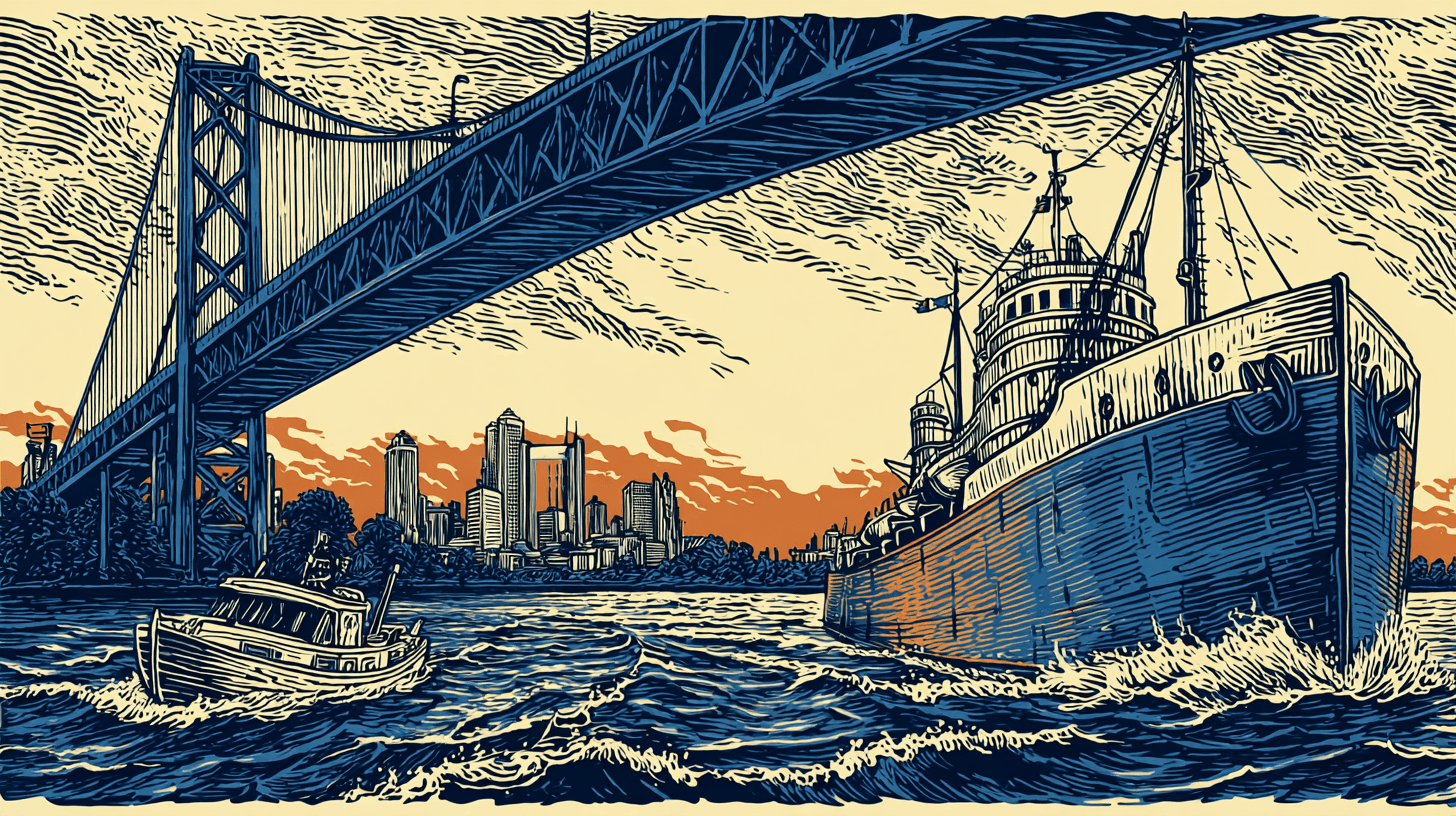
The thing people forget about St. Clair is that it's a working waterway. The channel that runs across it is part of the Great Lakes shipping system, and 700-plus-foot lake freighters use it the same way they use the Detroit River just downstream. You'll be out there on a Saturday in your 35-footer and a freighter the length of two football fields will come through the middle of the lake.
The rules of the road here are not complicated, but they are non-negotiable. Give commercial traffic a wide berth — all of it, all the time. A freighter can't stop, can't turn, and is restricted to the dredged channel because that's the only water deep enough to float it. You are the one with options. Use them.
Two specific hazards worth naming. First, the wake. A freighter's wake on shallow water can be substantial, and it'll reach you well after the ship has passed, so don't relax the moment it goes by. Second — and this is the one that hurts people — never run close alongside a moving freighter's hull. A large vessel underway sets up a suction effect that can pull a small boat in against the side of the ship. Stay well off. Cross behind, never try to squeeze across the bow, and keep your eyes up.
It Asks You to Pick Your Anchorage With the Wind in Mind
People do anchor out on St. Clair, and on the right day it's a fine place to spend an afternoon on the hook. Muscamoot Bay and Fisher Bay are the spots most people head for, and on a summer weekend Muscamoot turns into a raft-up scene.
But here's the honest part: this lake can be a miserable place to spend the night at anchor. Because it's so shallow and so exposed, even a modest wind — and the chop thrown off by passing traffic — can set up a short, confused, slapping motion that makes a boat pitch and roll at anchor even when the wind has dropped and everyone else has gone home. Plenty of cruisers transiting between Erie and Huron have pulled into St. Clair for an overnight and gotten almost no sleep for exactly this reason.
So if you're anchoring for a day swim, pick your bay for the wind direction that day and you'll be fine. If you're thinking about an overnight, think harder. A slip in a protected marina is often the better call on this lake than an exposed anchorage, and there's no shame in it. Setting a hook that actually holds is its own skill — I've written up how to anchor without drifting into anyone, and it matters more, not less, on a shallow lake where everyone's packed into the same two bays.
It Asks You to Have a Plan When You Cross It
Most people's real relationship with St. Clair is as a connector. It's the link between Lake Huron up the St. Clair River and Lake Erie down the Detroit River, and a lot of boaters cross it as one leg of a longer trip — heading up to Lake Huron's harbors, or running south for the season.
If that's you, treat the crossing as its own piece of planning, not an afterthought between the two rivers. Pick your weather window for the lake itself, not just for the rivers on either end, because the open middle of St. Clair is where you'll feel the wind. Know your channel, know your exits, and know which protected bay or marina you'll duck into if the wind comes up before you're across. The same trip-planning logic applies whether you're crossing St. Clair for an afternoon or making the run across Lake Huron: the captains who don't get caught out are the ones who decided where they'd go if the plan fell apart, before it fell apart.
None of This Is a Reason to Stay In
I want to be clear, because this can read like a list of warnings. St. Clair is a wonderful lake to boat on. It's central to everything in this region, it's ringed with good marinas and clubs, the fishing is some of the best in the country, and most days it gives you exactly the easy afternoon it looks like it will.
The point isn't fear. It's that "small and shallow" is a description, not a difficulty rating. Treat the lake like the working, weather-sensitive, shallow water it actually is — watch the wind, respect the channel, give the freighters their room, and have a plan for crossing it — and it'll be one of the best home waters a boater could ask for.
If you're newer to St. Clair, or you've just moved up to a bigger boat and the lake feels different than it used to, that's exactly the kind of thing a few hours of on-water coaching sorts out fast. And if you're running it as a leg of a longer delivery and would rather have a professional aboard, that's a conversation worth having before the season gets away from you.
WRITTEN BY
Captain Tom Ketelhut
USCG Master since 2009: 100 GT Great Lakes, 50 GT Near Coastal. Home port Grosse Ile, Michigan; deliveries and coaching from Lake Erie to Lake Huron, and in Florida.
WHERE TO NEXT
Keep going
More from Lake St. Clair

Raft Off at Muscamoot Bay: The Biggest Day on Lake St. Clair, Run Right
Read Next →

Keeping a Boat in Harrison Township: Marina Row, Anchor Bay, and the Ride Down the River
Read Next →

A Spotlight on the Grosse Pointe Yacht Club: The Tower You Steer By
Read Next →

Keeping a Boat in the Grosse Pointes: Harbors, Waitlists, and the Water Out Front
Read Next →

Boating Anchor Bay: The Shallow End of Lake St. Clair Is the Best End
Read Next →
More on Seamanship · next unread
If Your Boat Runs Aground: What to Do First and What to Check After
Read Next →

Boating in Florida vs. the Great Lakes: What Changes at the Helm
Read Next →

Leaving the Dock in Wind: The Line Everybody Casts Off First
Read Next →

Raft-Up Etiquette: How Not to Be That Boat in the Anchorage
Read Next →

Four Ways to Have a Safe Fourth of July on the Water
Read Next →

Right of Way on the Great Lakes: Who Yields and When
Read Next →
THE SERVICE THAT HELPS
Delivery, coaching and First Mate training on Lake St. Clair.