A Spotlight on the Ford Yacht Club: The Place That Taught Me What a Boating Community Is
I served as its Commodore. An honest, insider's look at the Ford Yacht Club on Grosse Ile — its history, facilities, calendar, and what a club like it does for a boater.

Captain Tom Ketelhut
I've held a lot of titles on the water. The one that taught me the most didn't come with a license. It came with a work assignment, a clipboard, and a few hundred fellow members who expected me to show up.
I served as Commodore of the Ford Yacht Club, here on Grosse Ile, from 2004 to 2006, and I sit as President of the club's Past Commodores today. So when I tell you what this place is, understand that I'm not a visitor admiring the view. I helped run it. I've put in my work hours like everyone else, sat through the board meetings, and watched it turn nervous new owners into people who could bring a boat into a crosswind without raising their voice. This is the first in what I'm making a recurring series on this blog, a look at the institutions and people that make boating in southeast Michigan what it is. I'm starting with the one closest to home.
History
The Ford Yacht Club was begun in 1947 by a small group of Ford Engineering employees, presented to the Ford Recreation Department, and formally organized with fifteen charter members. According to the club's own history, the stated objective was to establish a yacht club to foster boating activities for families of moderate means, a constitution was adopted, and William C. Vincent was elected the first Commodore. That objective wasn't a slogan. It was the actual mission, and you can still feel it in the place today.
Vacant land at the southern tip of Grosse Ile was selected in 1948. After a lot of planning and clearing, the club burgee flew for the first time at the dedication ceremony on October 2, 1948, and the club held its first regatta that same day, two races followed by a potluck picnic. The first clubhouse went up in 1949: an 18-by-24-foot building, with annual dues set at fifteen dollars. I think about that number every time I write a check to the place now.
What followed was decades of members building the club out by hand. The women's auxiliary, named the First Mates, was started in 1953 and is still active today. Work on the West Basin sea walls began in 1960. The club rode out high-water and low-water years, dredged its own harbors, and kept expanding the docks. By 1988 the club had 565 members and closed new memberships. The clubhouse most people know today came out of a major project at the end of the 1980s: the old building was demolished in early 1990, the regatta that August ran on food service from a tent, and the new clubhouse opened on December 2, 1990, with over 500 people in attendance.
The slow, steady improvement never really stopped. The East Basin was completely rebuilt in 2013 with forty larger docks, new seawall, and dredging. A Learn to Sail program was implemented in 2014. And in 2021 the club finally built a swimming pool complex, a proposal that, for the record, the membership had voted down back in 2006. That's how a member-run club works. Some ideas take fifteen years and a couple of votes to land.
By the numbers
Founded 1947
15 charter members
First Commodore: William C. Vincent
Dedicated October 2, 1948
First clubhouse built 1949, dues $15/year
Current clubhouse opened December 2, 1990
174-acre property
281 boat wells
Winter storage for ~500 boats
The clubhouse
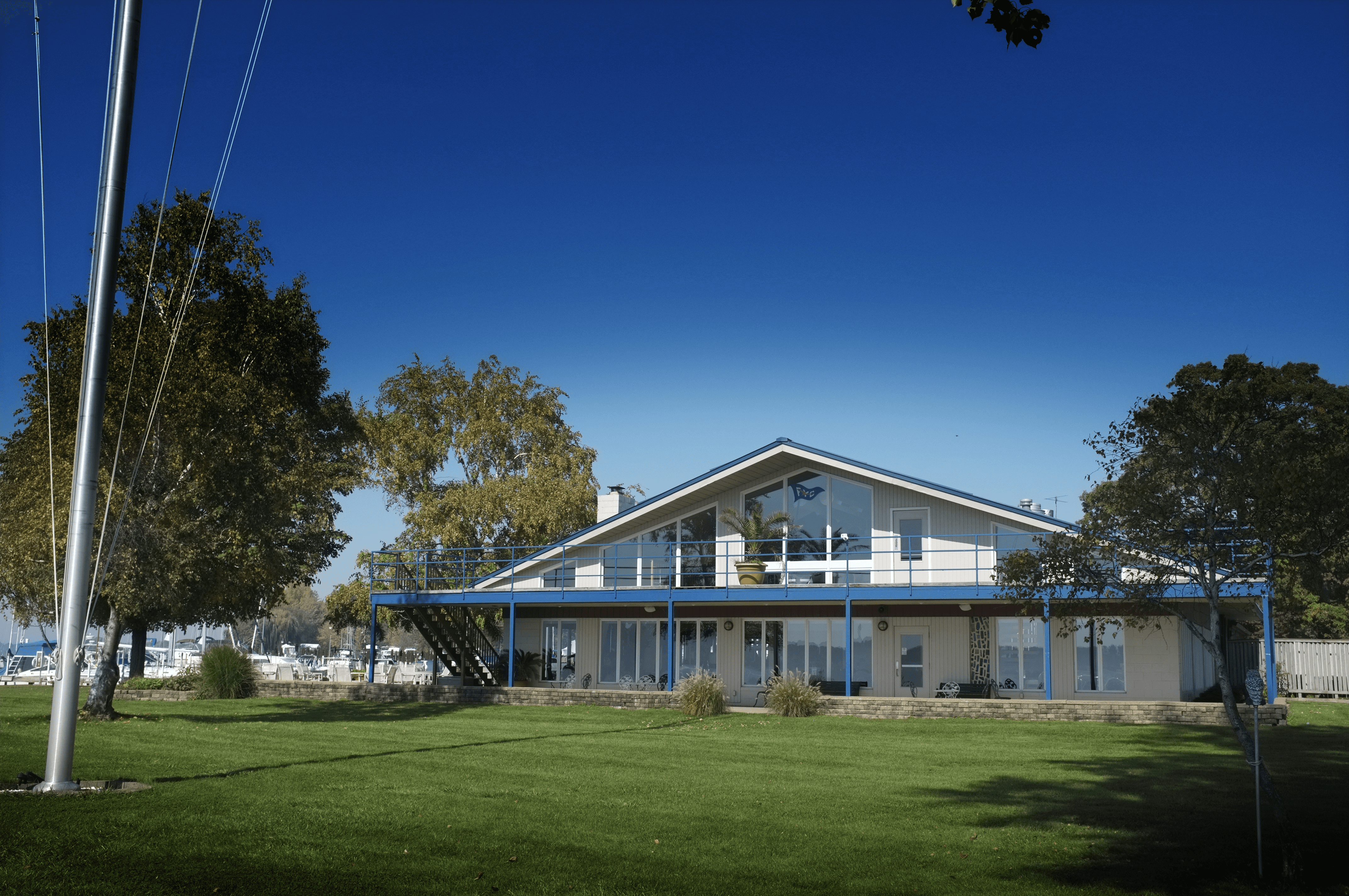
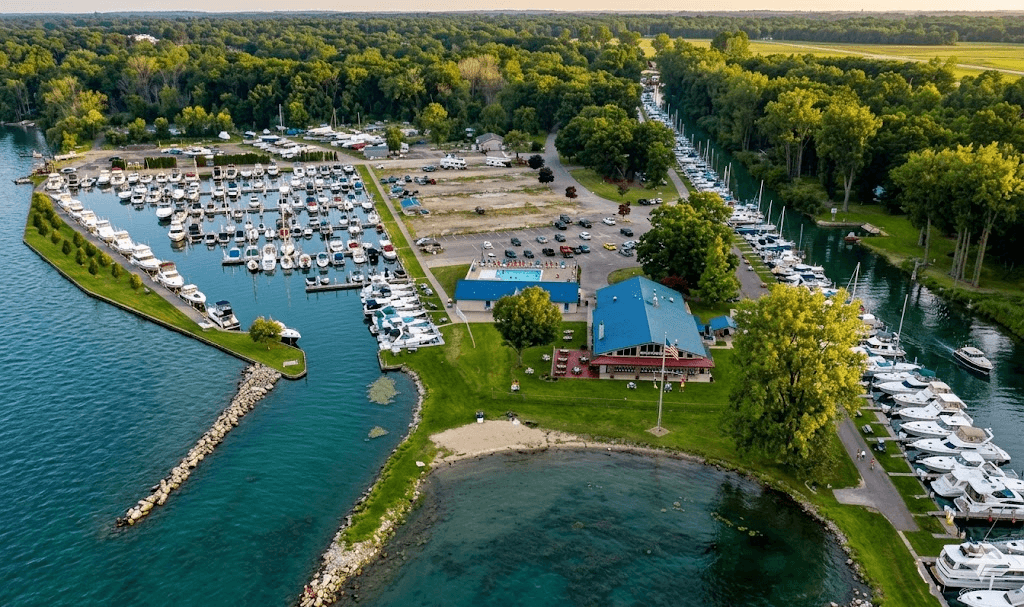
The current clubhouse sits right where the two harbors meet, and its outside balcony has a view of Lake Erie that's hard to beat anywhere downriver. The main floor holds the dining room, the lounge, the Ships Store, the office, a kids' room, and the restrooms. There's a patio with its own bar and food service, a front inside balcony for smaller gatherings, and a board room off the back balcony.
The dining room seats 150 and runs a fresh menu every week alongside the regular one. The separate cocktail lounge seats 50, with nightly drink specials and a standing Euchre game on Wednesday nights. The Ships Store, stocked with nautical gear and gifts carrying the club logo, is run by the First Mates, which tells you something about how the place operates: the women's auxiliary founded in 1953 still runs the store on weekends. There's a detail I always liked, too. The back lobby is accessible 24 hours a day, 365 days a year, with heated restrooms and showers available from the outside, so a member coming off the water at an odd hour always has a warm, dry place to land.
The facilities
This is where the club earns its reputation among boaters, and where I think it quietly outperforms places with fancier reputations.
The marina runs 281 boat wells ranging from 25 to 60 feet, every one of them wired for electricity and plumbed for city water. There are two separate harbors. The East Basin sits on Frenchman's Creek and carries the working infrastructure: the travel lift, the gin pole for stepping and pulling masts, the fuel dock, and the pump-out. The West Basin runs docks A through H, with H out on Banana Island and the visitors' dock at the end of A as you come in. The clubhouse splits the two harbor entrances.
The fuel dock is open around the clock and carries ethanol-free gasoline and premium diesel, which is more than I can say for a lot of marinas, and the club can haul and launch sail and powerboats up to 15 tons on the travel lift, with a separate 3-ton single-point lift and a kayak rack on the northwest side. Winter storage runs for roughly 500 boats, with members certified to run the travel lift handling the haul-outs and launches themselves. If you've read my spring launch checklist, you know how much smoother splash day goes when the people running the lift actually know your boat. At a club like this, they do, because they're your neighbors.
The grounds run 174 acres, semi-wooded and genuinely secluded. There are picnic areas, big gas grills, a renovated playground, a small basketball court, a sandy beach, and a bonfire pit with benches down by the water. To the east, undeveloped Round Island shields the whole complex and gives it privacy you don't expect this close to Detroit. To the west, Banana Island is planted with Cleveland pear trees and frames the view back toward the river. The harbormaster monitors VHF Channel 69 if you're ever coming through.
Annual events
A club is its calendar, and this one stays full in every season.
The marquee event is the FYC Regatta, which traces back to that very first dedication day in 1948 and has grown into a multi-day event that, in recent years, has hosted the Associated Yacht Clubs Poker Run with dozens of visiting boats. The racing itself is serious. The Sail Committee runs active fleets in PHRF-LE big-boat racing, S2 7.9 one-design, Lightning one-design, and cruising-class races, plus the relaxed Sunday Funday "Rum Races" most Sunday afternoons where cruising boats are not just welcome but encouraged.
There's real history in those fleets. The Ford Yacht Club is home to Lightning Fleet 233. The Lightning was the first class of boats sailed out of the club when it was founded, and it's the reason there's a lightning bolt on the club burgee. The club also hosts a Lake Erie Championship and partners with Sail GI, a nonprofit that teaches sailing and safe boating to club members and to veterans and active-duty military, which is exactly the kind of thing a club ought to be doing with its water and its time.
Off the water, the social calendar is just as old. The Commodore's Spaghetti Dinner has run annually since 1973. The Blessing of the Fleet, a passing-in-review that's a genuinely moving thing to watch, dates to 1982. The Commodore's Ball, the Change of Watch, theme dinners in the lounge, an antique car show on the lawn that members started back in 1992, the kids' Easter egg hunt, the First Mates' events. Add in the rendezvous, organized runs by boat and by bus to ports all over Lake St. Clair, the Detroit River, and Lake Erie, and there's something on the books in all four seasons.
What a club like this actually does for a boater
I coach people for a living now, and I'll tell you plainly: a lot of what I teach, people used to learn at clubs like this one. Not in a classroom. On the dock, from the slip neighbor who'd done it a hundred times and didn't mind showing you once. A good club is a competence multiplier. You watch better boaters dock in a crosswind. You ask the question you were too proud to ask the broker. Somebody who's run to the North Channel forty times tells you which anchorages are worth the trip and which ones to skip. If you want a sense of what that on-the-dock learning looks like written down, my piece on docking covers the part most people are too proud to practice.
The Ford Yacht Club also sits right at the front door of some of the best cruising in the country. If you've read my Great Loop guide, you know I think the run from the Detroit River out into the western basin of Lake Erie is criminally underrated. The club is built on that gateway, and the structured sailing instruction it still offers, from Learn to Sail on up, is exactly the foundation the sport needs and is getting harder to find anywhere.
—
I don't say any of this to sell you a membership. The club doesn't need my help with that, and joining one isn't the right move for everybody. I say it because when people ask me how to get better on the water faster, my honest answer is usually some version of what a club like this provides: time around people who know more than you, in a setting where asking for help is normal instead of embarrassing. I just happen to offer a more concentrated version of it, one-on-one, on your own boat.
So if you keep a vessel anywhere from the Detroit River out to Lake Erie and you've never thought about what a club could do for your seamanship, it's worth a look. And if you'd rather skip ahead and get confident on your own boat without waiting for the right slip neighbor to come along, that's the kind of thing I help with. Either way you come out a better boater. That's the only outcome I'm actually rooting for.
WRITTEN BY
Captain Tom Ketelhut
USCG Master since 2009: 100 GT Great Lakes, 50 GT Near Coastal. Home port Grosse Ile, Michigan; deliveries and coaching from Lake Erie to Lake Huron, and in Florida.
WHERE TO NEXT
Keep going
More from Detroit River

More on From the Dock · next unread

Don’t Teach Your Partner to Dock the Boat
Read Next →

Raft Off at Muscamoot Bay: The Biggest Day on Lake St. Clair, Run Right
Read Next →

A Spotlight on the Grosse Pointe Yacht Club: The Tower You Steer By
Read Next →

What Your Boat Snacks Say About You
Read Next →
Boat Guest Etiquette: A First-Timer's Guide to Getting Invited Back
Read Next →
Five Things Worth Getting Right Before Memorial Day Weekend
Read Next →
THE SERVICE THAT HELPS
Coaching, deliveries and First Mate training for Grosse Ile boat owners.