A Spotlight on the Grosse Pointe Yacht Club: The Tower You Steer By
I run this lake for a living, and its tower is the first thing I see from the water. A working captain's look at the Grosse Pointe Yacht Club.

Captain Tom Ketelhut

On a clear morning on Lake St. Clair you can pick out the Grosse Pointe Yacht Club tower from a long way off. Before the shoreline sorts itself into individual houses, before you can read a single channel marker, the tower is already standing up off the north shore. It has been doing that since 1929. The building was made to be seen from the water, and from where I usually sit, at the helm of somebody else's boat, that is still the most useful thing about it.
I'm not a member. I run this lake for a living, moving boats up and down it and coaching owners who keep theirs here, and in that line of work you get to know the fixed things on a body of water better than most of the people who own homes along it. This is the second piece in a series I'm writing on the clubs and institutions that make boating in southeast Michigan what it is. The first was my own club, the Ford Yacht Club down on Grosse Ile, which I wrote from the inside, having served as its Commodore. This one I'm writing from the outside, from the cockpit rather than the ballroom. That turns out to be the right seat for this club, because what the Grosse Pointe Yacht Club is to most boaters on this lake is exactly that: a thing you see from the water.
History
The club started on the ice. In its earliest form, around 1910, it was the Grosse Pointe Ice Boat Club, and it's commonly dated to 1914, when a couple dozen sailing and iceboating enthusiasts organized it properly. If that sounds odd for a yacht club, it shouldn't. Lake St. Clair freezes hard, and iceboating was serious business here long before fiberglass showed up. For its first decade the club had no home of its own and met in members' houses and the local municipal building.
That changed in the late 1920s, when the club set out to build something grander than anything else on the lake. Land was secured at Lakeshore and Vernier, the harbor was dug in 1928, and the spoils dredged from the lake bottom were used to build up the very ground the clubhouse sits on today. The clubhouse went up in about sixteen months and opened on July 4, 1929, roughly three months before the stock market crashed.
The building was the work of the Boston architect Guy Lowell, whose other commissions included the Boston Museum of Fine Arts and the New York State Supreme Court building. Lowell died at sea in 1927, off the Madeira Islands, before the plans were finished, which makes the yacht club the last major building he designed. His associates carried it to completion. There is something fitting, and a little sad, about a yacht club being the final work of an architect who was also an accomplished sailor and who died on the water.
The early roster read like a directory of Detroit's industrial age. Edsel Ford, Horace Dodge, and Russell A. Alger, the last a former Michigan governor and U.S. senator, were among the early members. That Ford connection is worth a note here, because the club I wrote about first, the Ford Yacht Club, was founded a generation later by Ford Engineering employees. The name turns up on both ends of this water, in two very different clubs.
The timing of the opening was brutal. The club opened deep in debt, the Depression arrived, and by 1935 the mortgages had won and the doors closed. A group of members bought it back out of receivership and reopened it in 1938, and it has run continuously since, through the war years and into a long stretch of prosperity. In 2015 the clubhouse was added to the National Register of Historic Places, recognized for its architecture and its place in the history of the Grosse Pointes. The club marked its centennial in 2014.
By the numbers
Roots as the Grosse Pointe Ice Boat Club, around 1910
Organized as a club, 1914
Clubhouse opened July 4, 1929
Architect: Guy Lowell — his final major design
75,000-square-foot clubhouse, Italian Renaissance style
187-foot bell tower with a 5,000-pound bronze bell
Closed 1935, reopened 1938
Added to the National Register of Historic Places, 2015
Deep-water harbor: 252 slips, private gas dock, certified Clean Marina
Member, Detroit Regional Yacht-racing Association
The clubhouse and its tower
The clubhouse sits at 788 Lake Shore Road in Grosse Pointe Shores, just north of Detroit. It's a 75,000-square-foot Italian Renaissance building in rough-finished stucco, and its bell tower rises 187 feet. That tower is a genuine landmark, not a figure of speech. The Detroit Historical Society calls it a well-recognized landmark to boaters around the lake, and it is formally regarded as a navigational aid for exactly that reason. It carries an aviation beacon at the top and catches the light long before anything else on that stretch of shore.
For a captain, that matters in a practical way. Lake St. Clair is big, shallow, and short on tall reference points. When the haze sits on the water in the morning and the far shore is a gray smudge, a hard vertical you can trust is worth something. You don't navigate by it the way you would a lighted buoy, but it orients you. It tells you where the north shore is and roughly where you stand against it, and on this lake that is often the first thing you can see clearly.
The tower isn't just tall. It holds a five-foot bronze bell weighing 5,000 pounds, cast by the Meneely Bell Foundry, the firm tied to bell work at Independence Hall. The way the club's own history tells it, the tower was conceived as a ship's clock for the whole lake, its bell striking the hours and half-hours for boats within earshot, its height doubled by the reflection on calm water. That is a sailor's idea, not an architect's, and I've always thought it reads clearly in how the thing looks from out there.
Inside, a fifty-foot foyer opens into a rotunda, and the octagonal main dining room runs about seventy feet across with a wall of windows facing the lake. You may have seen the building without knowing it, since the tower turns up in the closing credits of Gran Torino and in an aerial shot in Grosse Pointe Blank. But the version that matters to a boater is the one framed by your own windshield on the way up the lake.
The harbor and the grounds
Behind the clubhouse is one of the older protected harbors on this side of the lake, and a substantial one. Today the club runs a deep-water marina of 252 slips with its own gas dock, certified as a Clean Marina and staffed around the clock through the summer, per the club's harbor information. That deep water is worth knowing if you run boats out here. The municipal harbors along the Grosse Pointe shore mostly top out around 55 feet, which I got into in the piece on keeping a boat in the Grosse Pointes. GPYC's harbor takes the bigger stuff.
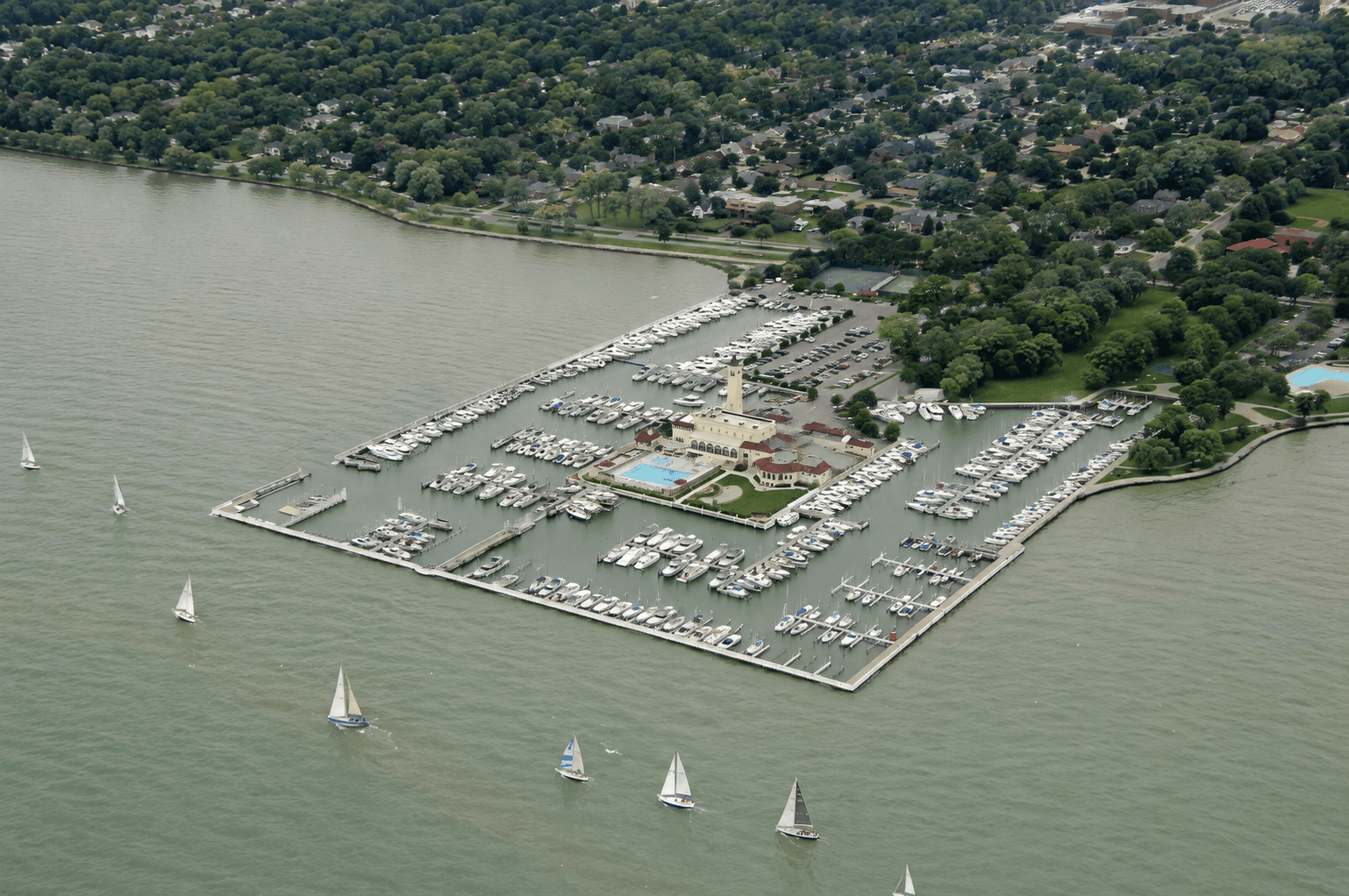
It's a private club, and that shapes how a captain deals with it. This isn't a public fuel-and-go marina you drop into on a whim. Boats come and go as members, as members' guests arriving by water, or as visiting members from reciprocal clubs. If you're bringing a reciprocal member's boat in, the club asks for a letter of introduction from the home club a couple of days ahead and a check-in at the front desk on arrival, per GPYC's guest information. Sort that out before you cast off, not while you're idling off the harbor mouth. The harbor monitors VHF Channel 9.
The approach itself is Lake St. Clair being Lake St. Clair. The water out front is shallow and builds a short, steep chop in a hurry when the wind comes up, which I covered in the Lake St. Clair piece. On a calm morning it's an easy run in. On a blown-out afternoon with a crosswind setting you down onto the pier, it rewards having your lines and fenders set and a plan agreed with your first mate before you're anywhere close.
Beyond the harbor, the club runs the full slate you'd expect from a place this size: an Olympic-sized pool, tennis, pickleball and paddle-tennis courts, a rebuilt bowling center, trap shooting, several dining rooms and a ballroom, per the club. None of that is my department. But one part of it is squarely a boater's business, and it's the part I respect most.
On the water
The Grosse Pointe Yacht Club belongs to the Detroit Regional Yacht-racing Association and runs two DRYA-sanctioned regattas a year, along with its own Summer Regatta and an August Fleet Review where members light up the harbor with decorated boats. Its Blessing of the Fleet, held on Memorial Day, is the same tradition my own club keeps: the boats blessed for a safe season before the summer gets going.
The part that matters most, to my eye, is the teaching. The club runs an adult sailing school and a junior sailing program that's been recognized nationally and has sent sailors on to the Olympics and professional careers. Kids come up through Optis and 420s and a racing team. That's a real pipeline, the kind that puts competent hands on the water for the next forty years, and there aren't many clubs still doing it at that level.
What a club like this does for a boater
I coach people for a living, and I'll tell you plainly: a lot of what I teach, people used to learn at clubs like this one. Not in a classroom. On the dock, from the slip neighbor who'd done it a hundred times and didn't mind showing you once. A good club is a competence multiplier. You watch better boaters bring a boat into a crosswind. You ask the question you were too proud to ask the broker. Somebody who's run north forty times tells you which anchorages are worth the trip. If you want a sense of what that looks like written down, my piece on docking with confidence covers the part most people are too proud to practice.
The Grosse Pointe Yacht Club sits in the middle of some of the best day-water in the state. From that stretch of Grosse Pointe shoreline you're close to the open lake, close to the run up toward Anchor Bay, and close to the mouth of the Detroit River. The club is built on that position, and the sailing instruction it still offers is exactly the foundation the sport needs and is getting harder to find.
—
I don't say any of this to sell you a membership. The club doesn't need my help with that, and joining one isn't the right move for everybody. I say it because when people ask me how to get better on the water faster, my honest answer is usually some version of what a club like this provides: time around people who know more than you, in a setting where asking for help is normal. I offer a more concentrated version of it, one-on-one, on your own boat, whether that's coaching you on your own helm or delivering the boat itself across the lake at the front and back of the season.
So if you keep a vessel anywhere on Lake St. Clair and you've never thought about what the water around that tower has to teach you, it's worth a look. And if you'd rather get confident on your own boat without waiting for the right slip neighbor to come along, a quick call sorts out most of what you'd actually need. Either way you come out a better boater. That's the only outcome I'm rooting for.
WRITTEN BY
Captain Tom Ketelhut
USCG Master since 2009: 100 GT Great Lakes, 50 GT Near Coastal. Home port Grosse Ile, Michigan; deliveries and coaching from Lake Erie to Lake Huron, and in Florida.
WHERE TO NEXT
Keep going
More from Lake St. Clair

Raft Off at Muscamoot Bay: The Biggest Day on Lake St. Clair, Run Right
Read Next →

Keeping a Boat in Harrison Township: Marina Row, Anchor Bay, and the Ride Down the River
Read Next →

Keeping a Boat in the Grosse Pointes: Harbors, Waitlists, and the Water Out Front
Read Next →

Boating Anchor Bay: The Shallow End of Lake St. Clair Is the Best End
Read Next →
What Lake St. Clair Asks of Boat Owners
Read Next →
More on From the Dock · next unread

Don’t Teach Your Partner to Dock the Boat
Read Next →
Raft Off at Muscamoot Bay: The Biggest Day on Lake St. Clair, Run Right
Read Next →

What Your Boat Snacks Say About You
Read Next →
Boat Guest Etiquette: A First-Timer's Guide to Getting Invited Back
Read Next →
Five Things Worth Getting Right Before Memorial Day Weekend
Read Next →
A Spotlight on the Ford Yacht Club: The Place That Taught Me What a Boating Community Is
Read Next →
THE SERVICE THAT HELPS
Coaching, deliveries and First Mate training for Grosse Pointe boat owners.