Right of Way on the Great Lakes: Who Yields and When
There's no such thing as "having the right of way" on the water. There's only who's required to get out of whose way. Here's how it actually works.

There's no such thing as "having the right of way" on the water. I know that's not what you learned in your boater safety course, and it's not what the guy next to you at the fuel dock believes. But the Coast Guard's own rules are clear on this: the Navigation Rules don't grant rights, they assign responsibilities. One boat is required to keep clear. The other is required to hold course so the first one can predict what it's doing. That's the whole system, and the word "rights" doesn't appear in it.
That distinction matters more than it sounds. When you think you "have the right of way," you stop watching. You assume the other boat will move, you hold your line, and you get indignant when he doesn't. On Lake St. Clair on a Saturday in July, plenty of the people sharing the water with you have no idea what their obligations are. Being technically correct is poor consolation after a collision.
So here's how it actually works on our water, where it matters, and the one rule the Great Lakes plays by that nobody teaches well.
The give-way vessel and the stand-on vessel
Two terms do all the work. The give-way vessel is the one required to keep out of the way. The stand-on vessel is the one required to maintain course and speed so the give-way vessel can read it and maneuver around it. That's it. Forget "right of way." Think give-way and stand-on.
The reason the stand-on vessel has to hold course is practical. If both boats start maneuvering, neither can predict the other, and two indecisive captains is how boats end up trying to occupy the same patch of water. One holds, one moves. Predictability is the safety mechanism.
The two roles, plainly.
Give-way vessel: required to keep clear. Make your move early and make it obvious.
Stand-on vessel: hold your course and speed so the other guy can read you — until it's clear he isn't moving, and then you act.
The crossing rule: starboard wins
Most of your encounters on open water are crossing situations. Two power boats approaching from an angle, paths converging. The rule is simple and worth memorizing cold: when two power-driven vessels are crossing and there's a risk of collision, the vessel that has the other on its starboard side is the give-way vessel. It keeps clear, and it avoids cutting in front.
The old mnemonic still works. If a boat is on your right and you'd see its red sidelight, you give way — red means stop, you're looking at his port side. If the boat is on your left, you're the stand-on vessel, you hold course, and you'd see his green light. Green means go. The give-way boat should never see your colored sidelights at all, because it should be passing behind you, watching your stern.
But here's the part the safety-course version skips. The stand-on vessel isn't off the hook. The Coast Guard requires the stand-on vessel to take action herself the moment it becomes clear the give-way boat isn't doing his job. You hold course right up until holding course becomes the dumb move. Then you maneuver. Standing on your "rights" into a collision is its own violation. I'd rather you be alive and technically wrong than dead and technically right.
When you do maneuver, do it early and do it big. The rules call for changes that are large enough to be obvious to the other boat: a clear, decisive course change, not a series of nervous little nudges he can't read. A small correction at the last second reads as no correction at all.
The Great Lakes exception nobody teaches
Here's where our water differs from the textbook, and it's the rule worth carrying with you on the Detroit River and the St. Clair River.
Almost everywhere else, the crossing and head-on rules are the whole story. But on the Great Lakes and the Western Rivers, the Inland Navigation Rules carry a unique provision: a power-driven vessel proceeding downbound with a following current in a narrow channel has the right of way over an upbound vessel. The boat running with the current is stand-on. The boat fighting up against it has to give way and, in practice, propose how the two of you will pass.
The logic is sound once you've felt it. A vessel running downbound with current behind it has far less control. It can't stop or maneuver as crisply as the boat working upstream against the flow. So the rules give the less-maneuverable boat the stand-on role and put the burden on the one that can actually do something about it. On the Detroit River and the St. Clair River, where there's real current and a steady parade of traffic, this is the rule in play, not the open-water crossing rule. Know which direction you're going relative to the current before you start sorting out who yields.
When a freighter is in the channel, none of this applies to you
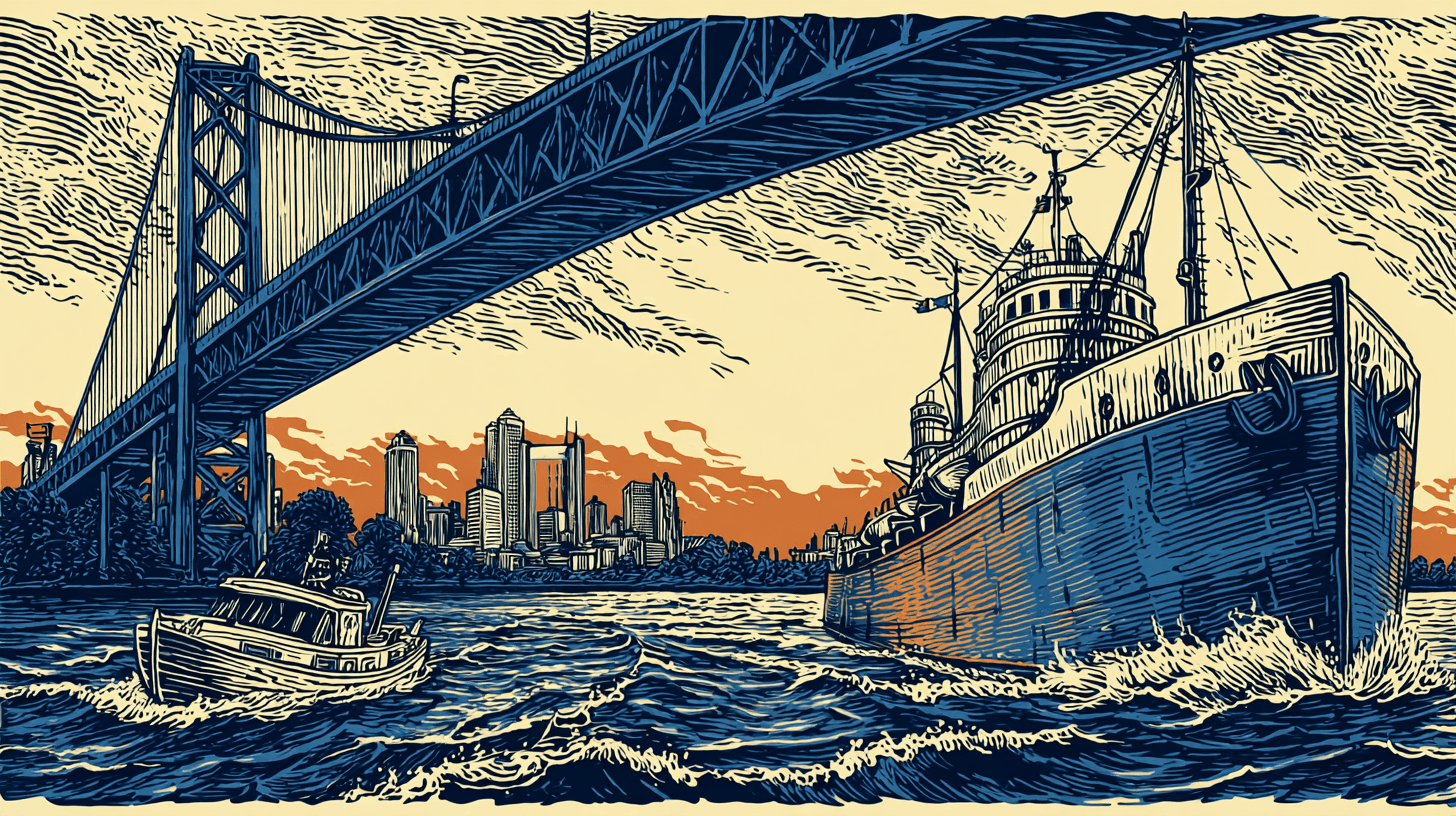
I'll be blunt about the rule that overrides all the others on our water. When there's a thousand-foot laker in the shipping channel, you are not in a crossing situation with it. You give way. Period.
A freighter that size can only travel within the dredged channel, and it can't stop or turn for you. The rules account for this directly. Vessels are required to avoid impeding a vessel that can only safely navigate within a narrow channel, and you must not cross a channel in a way that gets in the way of a ship that has no choice but to stay in it. Down on the Detroit River and the lower St. Clair River, that's a daily reality, not a once-a-season event. Stay off the channel edges, give the big ship a wide berth, and never assume a freighter sees you or could do anything about it if he did. He's watching a quarter-mile of stopping distance. You're watching a thirty-second decision. Make the easy one. If you need to talk to a ship before you cross his path, that's what the radio is for.
The same instinct applies, scaled down, to anything clearly less maneuverable than you: a sailboat under sail, a boat towing, a vessel that's obviously restricted. The pecking order isn't about size or attitude. It's about who can actually get out of the way. If that's you, then it's your job, regardless of what you think your "rights" are.
What to actually do out there
Strip away the terminology and it comes down to four habits. Keep a real lookout, not a glance every few minutes. Sort out early whether you're give-way or stand-on, and if there's any doubt, behave like the give-way boat. When you maneuver, make it early and obvious. And when something bigger or less maneuverable is in the picture, get out of its way and don't keep score.
That's the whole game. The rules reward the captain who acts early and decisively, and they have very little patience for the one who stood on his rights. If you want to drill any of this on your own water — crossing traffic on Lake St. Clair, the channel discipline the Detroit River demands, reading the current on the St. Clair River — it's exactly the kind of thing we work through in Captain's Coaching. A few hours of running real situations does more than any amount of reading.