Man Overboard Recovery: What Every First Mate Should Practice
The boat won't stop itself when the captain goes over the side. What the first mate does in the first ten seconds, how to get back to them, and how to practice it.

The captain sets the autopilot and steps down into the cockpit to clear a line trailing off the swim platform. You're inside with a coffee. A passing cruiser rolls the boat, and when you look aft, the cockpit is empty. There's a head in the water, already a hundred feet behind you.
The boat is still doing eight knots, and you're the only one aboard who can stop it. What happens next is man overboard recovery, and most of it gets decided in the first ten seconds.
It's a reasonable thing to be afraid of. Falls overboard account for 138 of the 556 recreational boating deaths in the Coast Guard's 2024 statistics, more than any other kind of incident. The recovery itself is mostly mechanics, though, and mechanics can be practiced.
The boat won't stop on its own
On a small runabout, a kill-switch lanyard would have shut the engine down the moment the driver went over. Federal law requires the operator of a boat under 26 feet to use that lanyard when running on plane. The rule stops at 26 feet, and it doesn't apply when the helm is inside an enclosed cabin.
On most of the boats my clients own, nothing shuts the engines down when someone goes over the side. The boat holds its speed until somebody pulls the throttles back, and if the autopilot is on, it keeps steering its course until somebody puts it in standby. If you've never had your hands on either, fix that at the dock this weekend. It's why running the boat is part of First Mate Coaching, not an extra.
The first ten seconds
Five things, in this order. They're short enough to memorize, and you should.
The first ten seconds.
Shout "Man overboard" and the side it happened on.
Throttles back and autopilot off. If they went in beside the boat, turn toward their side.
Throw something that floats.
Press the MOB button on the chartplotter.
Keep your eyes on them, and point if someone else is driving.
The turn matters most when someone goes in right next to the boat. Turning toward their side swings the stern, and the propellers, away from them. AMSEA, the Alaska group that trains commercial fishermen in marine safety, puts it plainly in its recovery guidance: keep the propeller away from them.
The Coast Guard requires a throwable flotation device on boats 16 feet and longer. It should live where the person at the helm can reach it, not in a locker under the cockpit cushions. Throw it even if you think it will land short. It's something to swim to, and it marks the spot.
Most chartplotters have an MOB button that drops a waypoint where you are, and plenty of first mates have never pressed it. Find yours before you need it. If you lose sight of them, or have to call for help, that waypoint is where everyone starts looking.
Keep your eyes on them the whole time you're turning. A head in the water is a small target in any chop. If anyone else is aboard, their only job is to point at it and not stop.
Getting back to them
Come back slowly. The instinct is to hurry, and hurrying is how a recovery turns into a second accident.
The standard approach, the one state boating courses teach, is to come alongside slowly while heading into the wind or current, whichever is stronger. Heading into it keeps the boat under control and keeps it from drifting down onto the person.
Big boats complicate that. A 30- to 65-foot boat carries a lot of hull and cabin above the water, and the wind pushes it faster than it pushes a swimmer. When the BoatUS Foundation tested crew overboard recoveries on a Grand Banks 42, the captain did it the other way: stopped one to two boat lengths upwind of the swimmer, shut down one engine, put the other in neutral and let the boat drift down until the swimmer was alongside, in the calmer water on its downwind side. It worked on that boat, in those conditions. It also takes practice to judge, and in rough water a rolling hull coming down on someone is the last thing you want.
Which approach suits your boat is something to learn with a fender in a drill, not with a person in the water. Either way, read the drift before you commit. If the boat is going to end up on top of them instead of beside them, reposition while you're still well clear. The propellers stop before you get close: nothing in gear once the person is within a boat length, and engines off once they're anywhere near the stern.
Getting them aboard is the hard part
Most boating courses give this step one line. AMSEA's guidance calls it often the most difficult part of the whole recovery.
Cold water is a big part of why. The National Weather Service notes that the gasping from cold shock can last two to three minutes, and that the loss of muscle control in hands and arms can start within seconds. The person you're picking up may not be able to hold a line, let alone climb a ladder. On Lake Huron, that's true even in July, and it's the best argument there is for the PFD already being on.
So get them attached before you try to get them aboard: a throwable with a line on it, or a dock line with a loop tied in the end, over their head and under their arms. Once they're tied to the boat, you can't lose them, and everything after that can go slower.
On most powerboats, the obvious way back up is the swim platform and its ladder, with the engines off. Don't assume it's the right one. In that same BoatUS test, a two-foot chop rolled the Grand Banks enough to turn its swim platform into a sledgehammer, and the swimmer took one look at it and chose to come aboard over the side instead, where a portable boarding ladder did the job. On a boat with a low platform in flat water, the platform can work fine. In any sea, the side may be the better climb.
If they can't climb at all, don't try to haul a soaked adult up the topsides by the arms. Keep them attached and alongside, and make the call. If your boat has a dinghy davit, a rescue sling on it can do the lifting: in the BoatUS test, a sling on the Grand Banks' electric davit raised the swimmer over its high sides easily.
And don't go in after them. That puts two people in cold water and nobody on the boat.
Make the call early
Don't wait until you've tried everything to pick up the radio. If you're alone on the boat, or the recovery isn't going to be quick, call as soon as the boat is under control: Mayday on channel 16, with the MOB waypoint as your position. The words and their order are in the first mate's emergency playbook. If your VHF has a DSC distress button, one press sends an automatic distress alert, and the Coast Guard urges in the strongest terms that the radio be connected to your GPS.
Then keep them attached, keep the engines off, and stay on the radio.
If you do get them aboard, and they're talking but need a doctor, the call becomes a pan-pan, the urgency call covered in VHF radio etiquette. If they're unresponsive or in rough shape from the cold, it's still a Mayday.
Practice it before you need it
The BoatUS testers came away with one line worth taping to the helm: "The more times a maneuver was done or a product was used, the more successful the crew was at getting the victim back aboard."
Here's the drill. Pick a calm morning with open water around you. The captain tosses a fender over the side without warning and calls "Man overboard." The first mate runs the whole recovery: the shout, the throttles and autopilot, the throwable, the MOB button, the turn, the approach, neutral, engines off, a boat hook on the fender, and the Mayday said out loud without keying the mic. Then trade places.
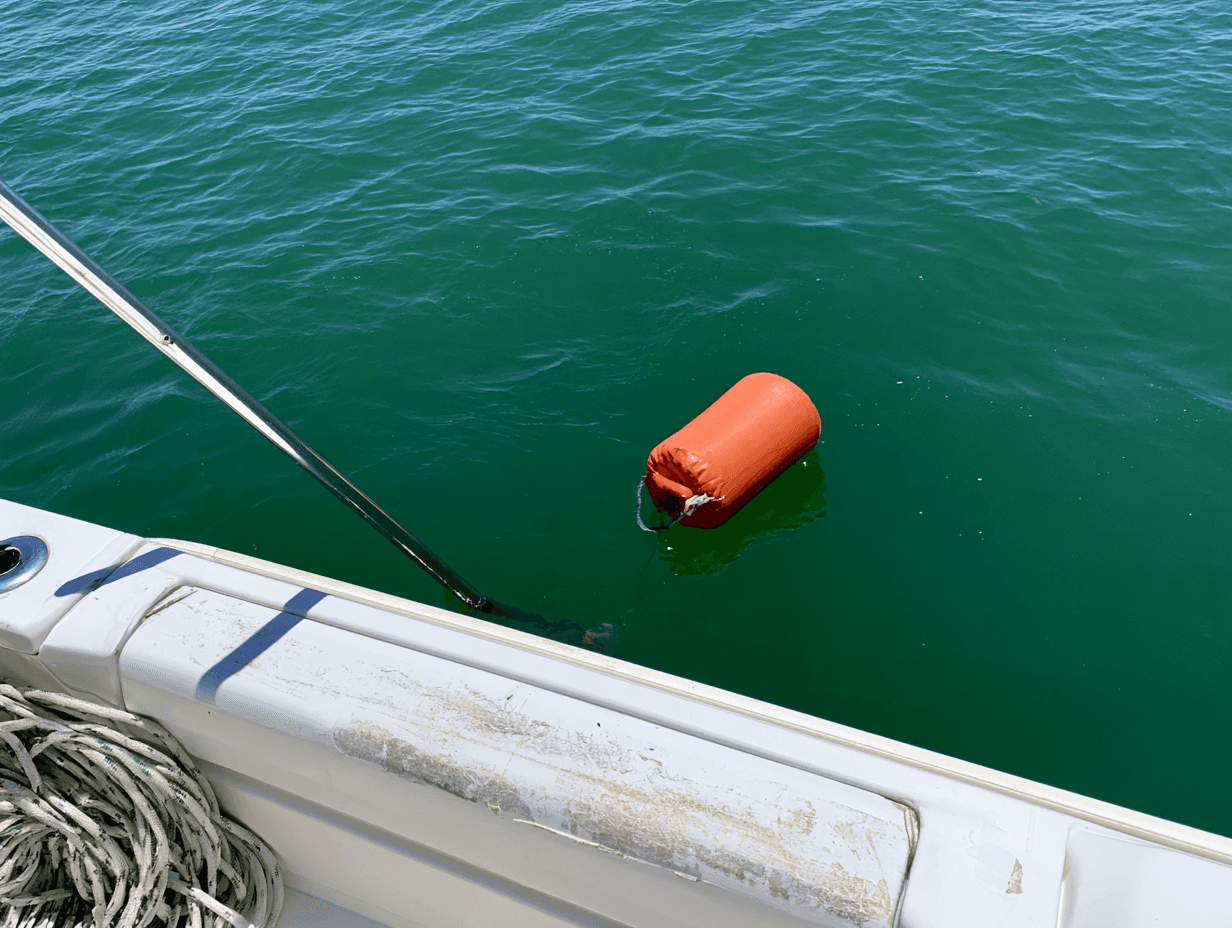
Run it again on a day with some breeze. Calm water teaches you the steps. Wind teaches you the boat.
Agree on the words ahead of time, the same way you'd agree on hand signals for docking. Then run it at the start of every season, because the first ten seconds only come back without thinking if you've done them recently. The man overboard drill is part of the Running Your Boat module in Captain's Coaching for the same reason.
Go back to that boat doing eight knots with an empty cockpit. The first mate who has run this drill a few times is at the throttles before they've finished being scared. If you'd like to run it on your own boat, in your own water, a quick call sets it up.