What the Boater Safety Course Leaves Out (And Where You Learn the Rest)
The boater safety course is a good course. It's just not about your boat. What the certificate covers, what it can't, and what to ask whoever fills the gap.

The boater safety course is a good course. It's just not about your boat.
I say that as someone who tells every new owner to take it, whether the law requires it of them or not. But every season I get calls from owners who passed it, framed the card, and then stood at the helm of a 38-footer in a crosswind and realized nobody had ever shown them what to do with the throttles. The course did its job. The job was never docking.
So here's an honest accounting: what the certificate covers, what it can't, and what to ask anyone who offers to teach you the rest. Because on the Great Lakes the second part is where the learning actually happens, and that's the part I do. Captain's Coaching exists for exactly the gap this article is about: your boat, your slip, your water.
What the course is for
Michigan requires a boating safety certificate for anyone born after June 30, 1996, who operates a motorboat, and for most personal watercraft operators regardless of age. You can earn it in a classroom, online, or through an interactive online version, and the DNR says plainly that conservation officers and county sheriffs would like everyone to take it, required or not.
I agree with them. The course syllabus covers general boating and water safety, the navigation rules, how crashes happen and how to prevent them, operation and fueling, environmental rules, and what to report when. That's the shared vocabulary of the water. The person coming at you at the mouth of the Detroit River in July is supposed to know the same rules you do, and the course is where most of them learned it. If you skipped it because you're old enough not to need it, go take it. It's a couple of evenings.
What it isn't, and never claimed to be, is a boat handling course. It teaches the rules that apply to every boat in the state. It cannot teach the one you own.
Your slip, your wind, your boat
Here's the list of things I get called about, in roughly the order I get called about them. None of them are on the test.
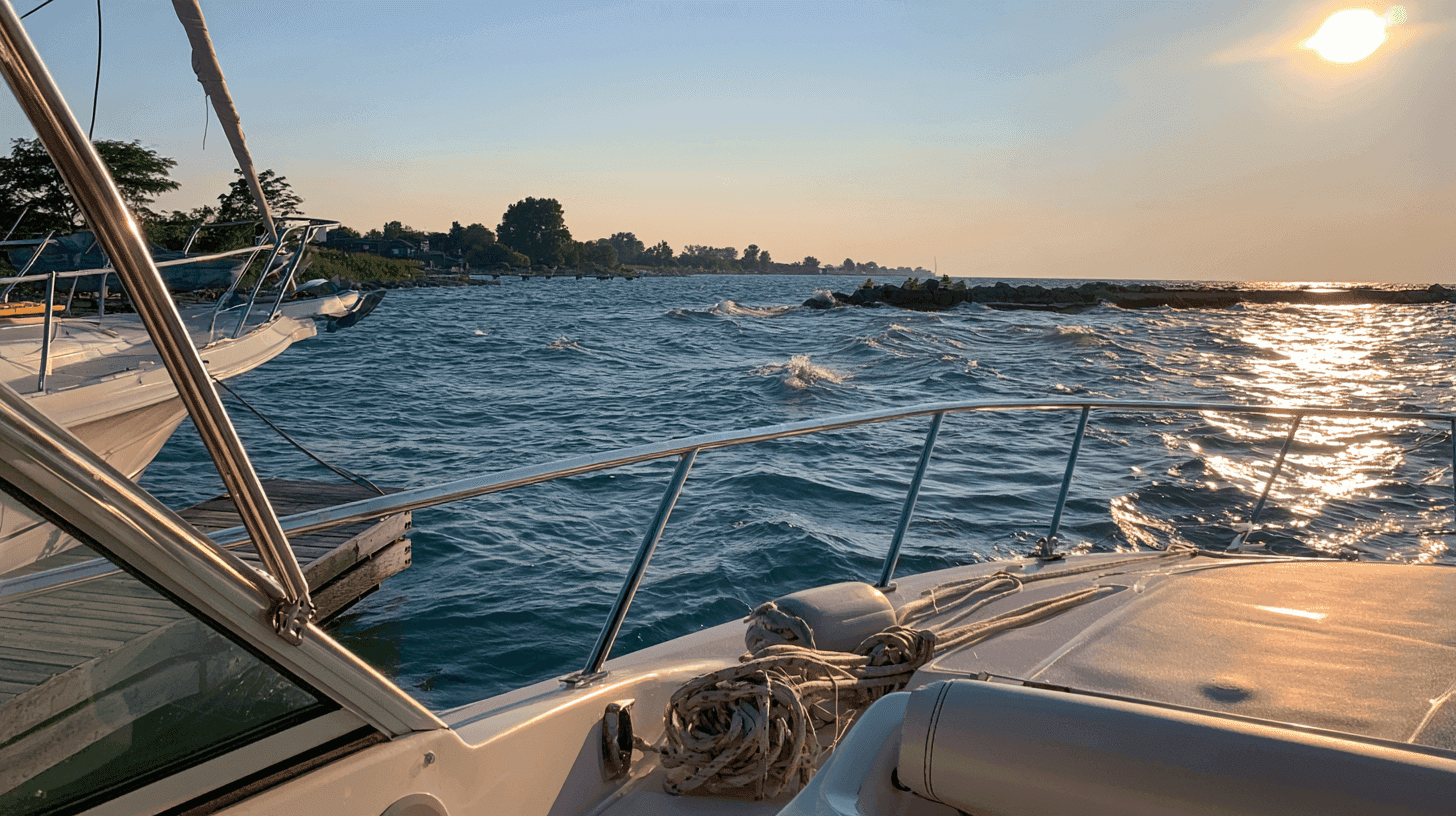
Getting in and out of your own slip. The course covers right of way. It does not cover the fact that your slip faces southwest, the afternoon breeze on Lake St. Clair comes out of the southwest, and your neighbor's bow pulpit is eighteen inches from your swim platform. Docking is a conversation between a specific boat and a specific piece of water, and there's no multiple-choice version of it.
What your propulsion actually does. A single sterndrive, a single inboard with a big rudder, twin screws, pods with a joystick: they all back down differently, pivot differently, and lose steerage at different speeds. The course can't know which one you have. The boat can only teach you if someone aboard already knows what she's about to do.
Where the current runs at your dock. On the Detroit River and the St. Clair River, the current is a permanent third crew member. It sets you off the wall on the way out and onto it on the way in, and it does it differently at every marina from Algonac to Gibraltar. Local knowledge isn't in the state curriculum because it can't be. It's in the people who run those docks every week.
The engine room. Strainers, fluid levels, leaks, blowers, done the same way before every departure. The course mentions fueling. It doesn't walk you through your own bilge with a flashlight.
Your crew. The course certifies one operator. Most boats I coach carry two people, and the one on the bow with a line in hand is doing half the work. Hand signals, who says what and when, what your partner does if you go in the water. That's a household skill set, not an individual one, and I've written about why the person you share the boat with is the wrong one to teach it.
None of this is a criticism of the course. It's a description of its edges. The certificate says you know the rules. It doesn't say you can run the boat, and your insurance carrier knows the difference, which is why a bigger boat sometimes comes with a requirement for hours with a licensed captain rather than a request for another certificate.
Online course versus on the water
I'm asked this more every year, usually by someone who found a well-produced video course and wants to know if it's a substitute for time aboard. My answer is that they're not competing for the same job.
A video can show you a spring line. It can explain prop walk with an animation and it can do it more clearly than I can with my hands. What it can't do is stand next to you when the boat doesn't do what the animation said, because your boat has a different hull, a different wind, and a different guy on the next finger pier watching. The test for boat handling is always on the water. Anything that happens before that is preparation, and preparation is valuable, but the course you take on the couch is never the last course. It's the reading before the lab.
How to pick who teaches the rest
This is the part nobody warns you about: there's no state license to teach boat handling on somebody else's boat. Anyone can put "instructor" on a business card. Some of the people who do are excellent. The way you tell is by asking, and the questions are short.
Six questions to ask before you hire anyone to teach you your boat
1. Do you hold a U.S. Coast Guard license, and what is your Mariner Reference Number?
2. Will you teach on my boat, in my slip, in whatever wind the day gives us?
3. If my insurance carrier wants hours with a captain, will they accept a letter from you? Check this with your broker, not the instructor.
4. Will you work with my partner or crew as well as with me?
5. What do we do if the day is too rough? Is there a plan or a refund?
6. Can I talk to two people you've coached on a boat like mine?
A word on the first question, since it's the one people feel awkward asking. A Coast Guard Master license isn't a certificate of enthusiasm. It means the Coast Guard examined that person, verified their documented time on the water, and looked at them medically before putting their name on a credential. The Mariner Reference Number is how a broker or an underwriter looks that credential up. Mine, along with the tonnage and the waters I'm licensed for, is on the credentials page. Ask the same of anyone else. A good instructor will have the number in their phone. One who changes the subject has told you something.
The third question matters more than it used to. Insurers on the Great Lakes are increasingly writing policies that require supervised hours before an owner runs a bigger boat alone, and the letter that ends that requirement has to come from someone the carrier will recognize. That's not something to discover after twenty hours with the wrong person.
Where the two fit together
Take the state course. Take it early, take it online if that's what gets it done, and carry the card. Then find the person who'll meet you at your slip.
That second part is what I do, from Lake Erie to Lake Huron. It isn't a classroom, and there's no test at the end except the one you give yourself the first time you bring her in clean with the family aboard. If that's the part you're missing, get in touch. A quick call usually sorts out what a first session on your boat should cover.