Bought a Boat in Florida? How to Get It Home
The New York canals close in mid-October. The Fort Lauderdale show opens two weeks later. What to settle before you sign, and how a boat bought in Florida gets home.

The New York canals close to boats in mid-October. This year the locks shut on October 14, and they won’t open again until spring. Two weeks after they close, the Fort Lauderdale show opens, and Florida’s boat-show season runs on through the winter.
Put those two calendars side by side and you have the first thing to know if you bought a boat in Florida and home is on the Great Lakes: she’s coming north in the spring, or she’s coming on a truck. If home is in Florida, the trip is shorter and the questions change: who runs her home, on what policy, and what she does on her first long day with a new owner.
Either way, most of the work happens before you sign.
Do you need a survey and a sea trial?
Yes. Get both, and write them into the offer so the deal depends on them.
They answer different questions. A marine survey is a report on the boat’s condition, and it’s what your lender and your insurance carrier will ask to see. I’ve written about what a marine survey covers and where its edges are. The sea trial is where you find out whether she runs the way the listing says and whether you can run her, which is a different question from whether she’s sound. What to check on a sea trial covers how to use that hour.
Buying from out of town raises the stakes on both. The sea trial may be the only time you see her run before she’s yours to move, and the survey is your last look under the floorboards before you fly home without her. That’s why I ride sea trials with buyers as part of my sea trial and purchase help.
The clock starts at closing
Three clocks start the day the boat becomes yours, and the trip home has to fit inside all of them.
Your insurance. Have the policy bound before you take possession, and tell the carrier where she’s going and how she’s getting there. Most policies have navigation limits, and one written for Florida water may not follow her up the coast. Whoever is at the helm needs the carrier’s OK too, usually in the form of a rider for a delivery captain. If this boat is a big step up from your last one, ask early whether the carrier wants hours with a captain before you run her alone. Time aboard during the delivery can count toward them if the carrier agrees, and the sign-off is the insurance check ride work I do.
Florida’s tax clock, if you live out of state. Florida exempts a boat from its sales tax when a nonresident buys it through a registered dealer or broker, as long as the boat leaves the state on time. Under 5 net tons, she has 10 days, or 20 days after the work is done if she goes straight to a registered repair facility. At 5 net tons or more, the dealer can issue decals good for 90 days, and an extension decal, bought from the dealer within 60 days of the sale, adds another 90, for 180 in all. If she comes back within six months and stays more than 20 days outside a registered repair facility, the tax comes due, plus a penalty the same size. The Department of Revenue’s guide for boat buyers lays out the rules and the paperwork. Your dealer and your tax advisor own the details. I watch the dates, because they set the delivery schedule.
The boater ID card, if you’ll run her in Florida. Anyone born on or after Jan. 1, 1988, needs FWC’s boating safety ID card to run a boat of 10 horsepower or more in Florida. A new owner has 90 days with the bill of sale aboard, and a nonresident’s NASBLA-approved course from home counts with a photo ID. FWC’s FAQ lists the rest of the exemptions.
Before you sign in Florida
Make the offer subject to a survey and a sea trial.
Have insurance bound from the day she's yours, with her route on it.
If you live out of state, ask the dealer about the nonresident exemption and its dates.
Decide truck or water, and book the captain or the carrier before closing day.
Know who will run her in Florida, and whether they need a boater ID card.
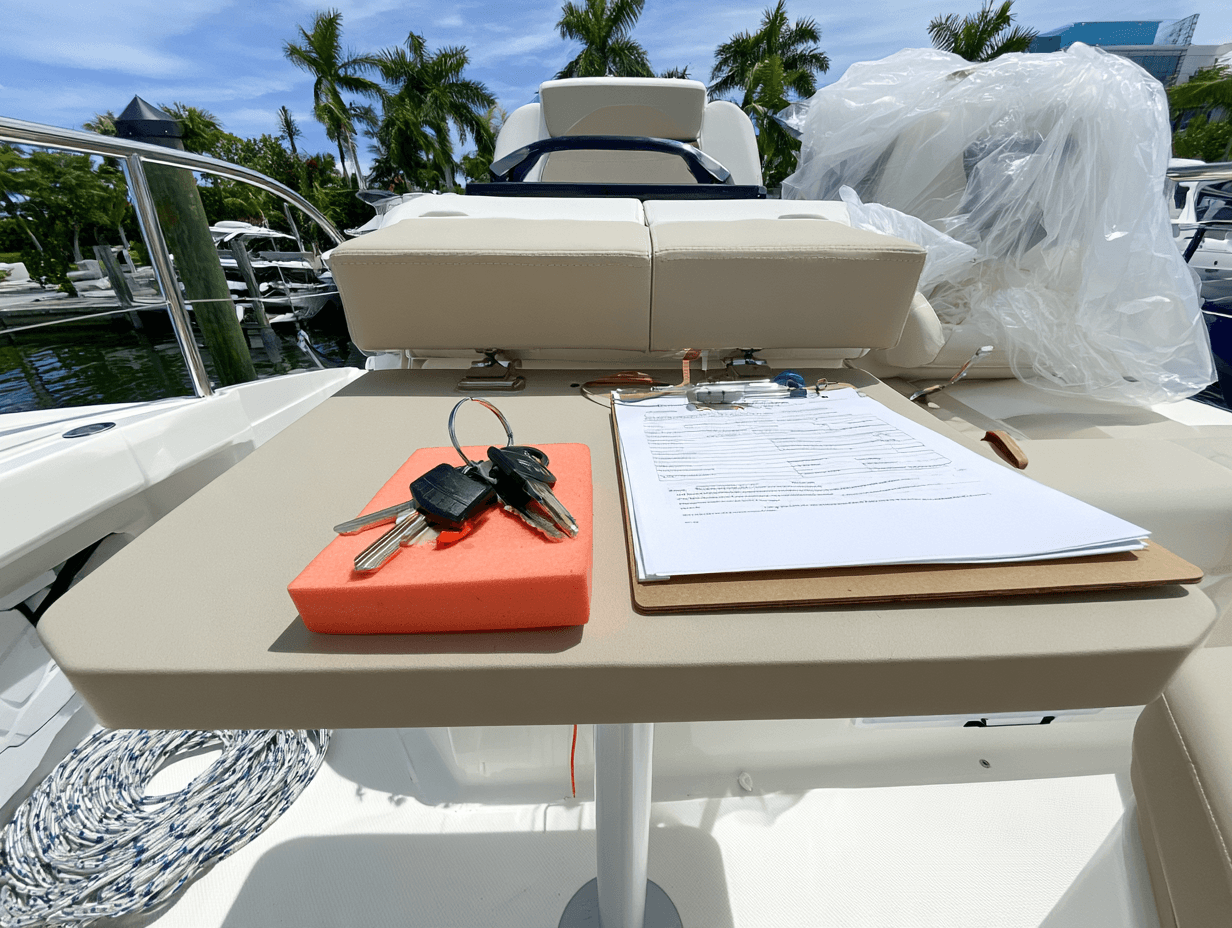
Truck or water
It’s the same comparison I walk Great Lakes owners through for the trip south, run in reverse: the size of the boat, her air draft, the calendar, and whether you want her run in by someone who writes down everything she does. My Great Lakes to Florida delivery guide goes through it.
The calendar is the part Florida buyers miss. A boat bought at a fall show can’t take the canal route north until spring, so the real choice is a truck this winter, or a winter in Florida and a run north in the spring. If the tax clock applies, check it against that plan before you sign. On a boat of 5 net tons or more, the 90-day decals and the extension carry a late-October purchase to late April. That fits an April departure, but the law doesn’t stretch the 180 days for weather, so plan to leave with days in hand. A smaller boat on the 10-day clock needs her ride out of the state booked before closing day.
A run inside Florida
If home is in Florida, the trip takes days instead of weeks: across the state on the Okeechobee Waterway, around to the other coast or down to the Keys. Plenty of these runs start at a dealer’s dock, and a new boat’s first long run is a test of its own. Fresh engines come with a break-in schedule to follow, and the small things the commissioning missed tend to show up in the first few hours under way. I work in Florida year-round, and the routes, run times and handoff are on my boat delivery in Florida page.
Bringing her north in the spring
Northbound, she leaves Florida in April and times her arrival at the Hudson to the canal opening. Count on four to six weeks, weather days included. Leaving in April also gets her out of Florida before hurricane season starts on June 1, which your carrier may care about as much as you do.
You can be aboard for all of it, some of it or none of it. If you can spare the time, ride along. An owner-assisted delivery puts you at the helm for the legs you want to learn, with a captain beside you the whole way. The first 50 miles on a new-to-you boat teach you more than a season at the dock, and this way they happen with help.
The winter before the run doesn’t have to be wasted. She needs a slip, coverage for Florida water and someone keeping an eye on her, and you can spend it learning her where she is, with lessons on your own boat in Florida.
If you’re buying in Florida this season, call me before you sign. A short conversation covers the survey, the sea trial and the calendar, and I’m happy to be the one who brings her home.
Keep Reading

FROM THE HELM
New articles, straight to your inbox.
A short note whenever a new piece goes up — seamanship, ownership, and lessons from the water. No spam, unsubscribe anytime.