Boat Hurricane Plan in Florida: What to Settle by June 1
Where she goes, who takes her there, and what your marina and insurer expect: the decisions that make a hurricane plan, and why they get made in the spring.

Most of a boat hurricane plan has nothing to do with lines and fenders. It's where she goes when a storm is coming, how she gets there, who takes her, and what your marina and your insurer expect from you. Those are phone calls, and they go best in the spring. Hurricane season runs June 1 to November 30, according to the National Hurricane Center, and once a storm is in the forecast, every yard, marina and captain you'd call is working against the same clock.
That goes double for a boat that stays in Florida while you spend the summer on the Great Lakes, because the plan has to work without you there. If she'll need a captain to move her, that's hurricane boat relocation. The plan is the same whoever runs her.
Start with the dock contract
Read your dock contract for the storm language, and ask the marina for its own hurricane plan. The BoatUS hurricane guide puts the contract first, because it can require steps of you when a hurricane threatens, and some say she has to leave. Some marinas also want a copy of your plan.
Florida law shapes what that contract can do. Under section 327.59 of the Florida Statutes, a marina can't enforce a policy that makes owners take their boats out once a hurricane watch or warning is issued; the law puts the owner's safety ahead of the property. What a contract can say is that if you don't move her promptly after a tropical storm or hurricane watch, the marina may move her out of her slip, if that's reasonable, or secure her itself, and charge you a reasonable fee. That clause has to appear as a notice to the vessel owner in at least 10-point type.
Even without that clause, once a watch is issued the marina can take reasonable steps to further secure her and bill you for them, and it can set the cleats, lines and fenders you use as a condition of the slip. It isn't liable for storm damage to your boat, though it is for negligence or intentional acts when it moves or secures her.
The exception is a marina inside one of Florida's deepwater seaports that has been deemed unsuitable for riding out a hurricane. There, boats under 500 gross tons can't stay once a hurricane watch is issued, and if the port orders boats out, it can fine an owner who doesn't move up to three times the cost of removing the boat. If your marina sits in a commercial port, ask which kind it is.
Pick where she rides it out
There are four choices, and the plan should name one of them and a second choice. Whether to move her at all comes down to two questions: is the new spot safer than her slip, and can she get there before the bridges lock down?
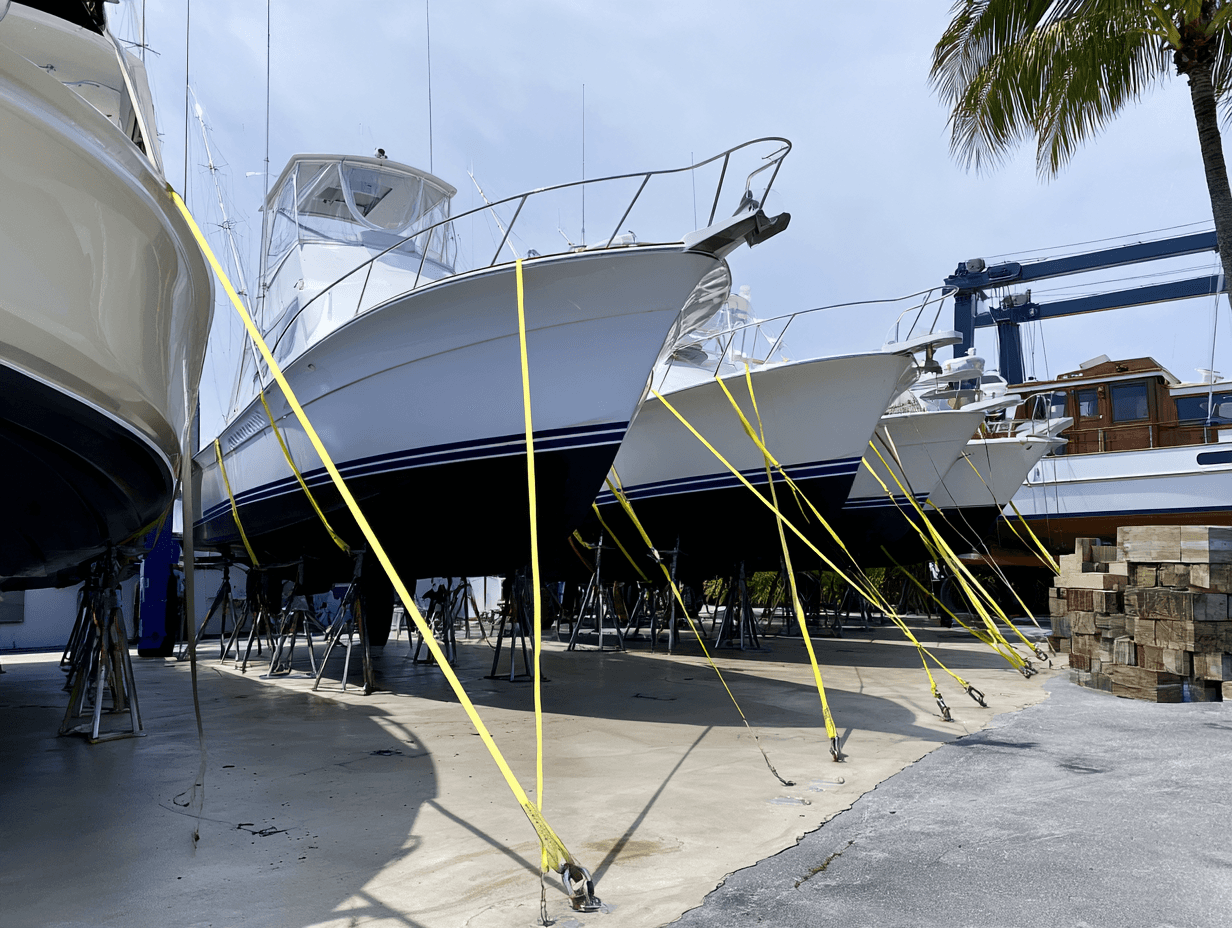
Hauled out. When BoatUS asked its catastrophe team where they'd put their own boats if a hurricane warning were posted, most said hauled ashore. If nobody will use her until fall, the simplest plan is to haul her before June 1 and leave her ashore for the season, strapped down. If she's staying in the water until a storm comes, some yards keep a storm haul-out list: you sign up well before the season, sometimes with a nonrefundable deposit, and the boats on it get hauled when a warning goes up, so she has to be at the yard by then. A boat that isn't on one may find the yard too busy to take her. It's the same reason fall haul-out books up in July on the Great Lakes.
An inland marina or a hurricane hole. That means a protected marina up a river, or a creek with good holding and trees to tie to. BoatUS's one-page hurricane worksheet asks the right questions: how long the run takes by water, which bridges have to open and whether they'll be opening, whether whoever owns the land around a hole has been contacted, and how you'll get ashore. Count on the run taking longer than it does on a calm day. The guide's example is a hurricane hole an hour away that takes two hours or more once the wind and seas build.
At the dock. If she stays, the plan is about lines. The Florida Fish and Wildlife Conservation Commission (FWC) tells owners to double every line, rig cross spring lines fore and aft, and tie high on the pilings to allow for the tide and any surge, with chafe gear wherever a line runs through a chock. Charge the batteries so the automatic bilge pumps can run through the storm.
Out of Florida. Some owners skip the question and bring her north before June 1. If that means home to the Great Lakes, that's the northbound run, timed to the canals.
Name who moves her, and when
The plan names a person, and a backup. If you'll be in Florida and you're comfortable running her ahead of a storm, that's you. If you'll be up north, or would rather not, it's a captain, and the time to pick one is spring. They'll need the keys or the gate code, your written authorization on file with the marina, a way to reach you, and whatever your insurer requires before someone else runs her. Insurance riders for a hired captain covers that conversation, and checking a captain's license takes about two minutes.
Then write down when you'll go. NOAA issues a hurricane watch 48 hours before tropical-storm-force winds are expected, and a warning 36 hours before. BoatUS's advice is to prepare or move the boat when a hurricane is a substantial possibility, before a watch is even issued, and that's the trigger I'd put in writing.
For the move itself, I'd rather work from the National Hurricane Center's arrival-time graphic than from the landfall forecast. Its earliest reasonable arrival time marks the point before which there's no more than a 1-in-10 chance of tropical-storm-force winds starting where you are. NHC describes the time before it as the window in which preparations should ideally be finished, for anyone with a low tolerance for risk. A storm move should be done well inside that window, because the bridges lock down and the ports restrict traffic before the wind arrives. I go through how that window closes on my hurricane relocation page.
Nobody stays aboard. FWC's advice is not to stay on the boat, and not to go out into rough conditions.
Call your insurer before June 1
Coverage can't be fixed late at all. The BoatUS guide puts it bluntly: once a hurricane is threatening, it's too late to get or change coverage. Four questions for your agent:
What does the policy pay toward a haul-out or a professional move ahead of a named storm, and when does that start? GEICO Marine, for one, includes named-storm haul-out coverage in every policy: it reimburses half the labor cost, up to a set limit, to have a boat professionally hauled or prepared once she's inside a NOAA named storm's cone, NHC's map of the storm center's probable track. It counts paid captains as professionals, and it pays only after you've paid the bill, so keep the invoice. Ask whether a move counts as "prepared."
How does the named-storm deductible work?
Does the policy say where the boat has to be during hurricane season, or want a written hurricane plan on file?
What does it need before someone else runs her?
After it passes
The plan's last line says who checks on her and how she gets home. The guide makes protecting the boat from further damage the owner's job, whatever shape she's in, and if she needs salvage, the first call goes to the insurer, not to a salvage crew. Plan on her staying put until the bridges open and the waterways reopen.
What goes in the plan
Where she goes, and a second choice
The route there, her running time, the bridges, and the depth at low tide
Who moves her, a backup, how they get aboard, and where her storm gear is
What the dock contract says, with the marina's contacts
What the policy pays and needs, from your agent
When she goes, written down
Who checks on her afterward, and how she gets home
A plan like that fits on one page, and it's the page you'll be glad to have in September. If your boat stays in Florida for the summer while you're up north, that's the kind of plan I help owners put together, and a quick call sorts out most of it.
Keep Reading



FROM THE HELM
New articles, straight to your inbox.
A short note whenever a new piece goes up — seamanship, ownership, and lessons from the water. No spam, unsubscribe anytime.