Moving Up to a Bigger Boat: What Actually Changes
Six feet of length can be nearly double the boat. Here’s what changes when you step up, including the insurance conversation most buyers have too late.

Moving up to a bigger boat starts as a feeling, not a decision. You’re waiting at the fuel dock behind something ten feet longer than yours, and you notice the cockpit. Then the master. Then the way she sits at the dock. By the time you’re actually shopping, the decision was made months ago.
The insurance industry has a name for the itch. They used to call it three-foot-itis, back when the typical step up was three feet at a time. Gallagher Charter Lakes, a marine insurance agency, writes that what they see now are jumps of fifteen feet or more.
I’m not here to talk anybody out of it. Most owners who move up are glad they did. But the boat you’re buying is a different animal than the one you have, and almost none of that difference is visible from the dock at a boat show. If the deal is already done, start with what I tell every new boat owner to do first.
Six feet on paper, twice the boat in the water
Take two boats from the same builder, the same series, the same hull designer. Cruisers Yachts makes a 34 GLS and a 42 GLS. On the transom that’s eight feet apart. Measured, it’s about six — 35’10” against 42’0”.
Now look at everything else. The 34 carries a dry weight of 14,530 pounds, a beam of 11’8”, and 29 inches of draft. The 42 comes in at 27,000 pounds, 13 feet of beam, and 43 inches of draft. Fuel goes from 217 gallons to 403.
Six feet of length. Nearly double the weight.
That ratio is the whole article. Length is the number on the brochure and the number you tell people at the club. It is not the number you feel. Every other figure moves faster than length does, and each one shows up somewhere specific:
Weight is momentum. Twice the mass at the same speed carries twice the energy toward the dock. The throttles you’re used to pulling back at forty feet out now need to come back at eighty.
Beam is fairway math. Thirteen feet of beam turning in a fairway laid out for a fleet of 30-footers is a different problem than the one you’ve been solving.
Draft is where you can go. Fourteen more inches under you matters on Lake St. Clair, where a lot of the good water is thin and most of the bad news is soft-bottomed.
Fuel is a maneuver. Four hundred gallons means the fuel dock stops being a stop and becomes a docking.
Windage is the one that surprises people
Weight you can anticipate. Windage catches people out.
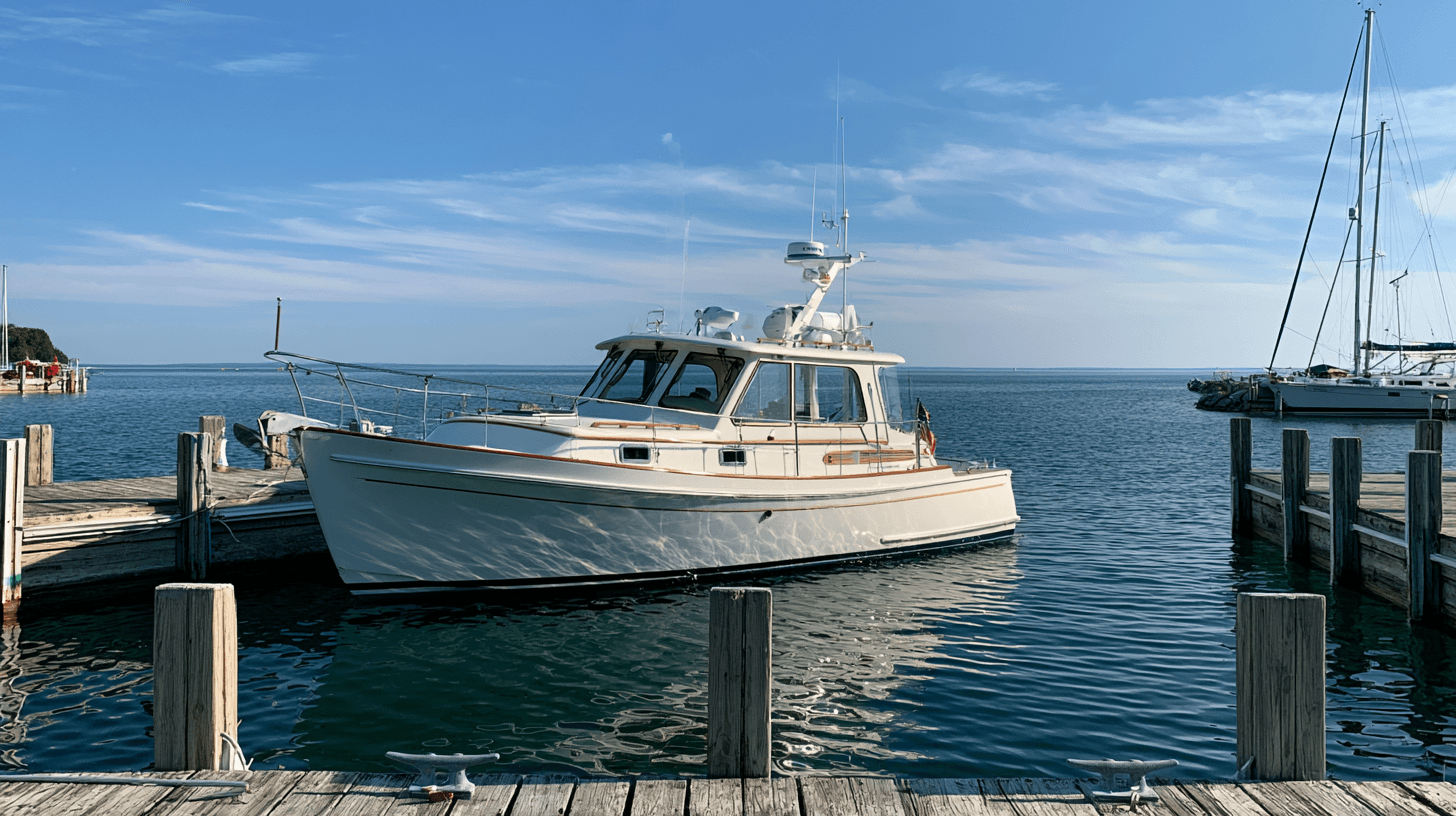
A bigger boat carries more house, more freeboard, more canvas, and more flybridge, all of it standing up in the air and all of it acting like a sail. The boat you have gets pushed by wind. The boat you’re buying gets sailed by it.
That would be manageable if the wind picked its moments. It doesn’t. It works hardest on you at idle speed in a fairway, which is exactly when you have the least steerage and the least room. Assessing wind and current before you commit to an approach stops being good practice and becomes the whole job.
Length changes the geometry too. The stern drives the boat, not the bow, and a longer boat swings her stern farther for the same amount of wheel. If you’ve built ten years of muscle memory on a 32-footer, that memory is now slightly wrong in a way that only reveals itself in close quarters. Docking is a learnable skill at any size. It just has to be learned again at this one.
You may have just become a two-person boat
This is the change most people don’t see coming, and it causes the most arguments.
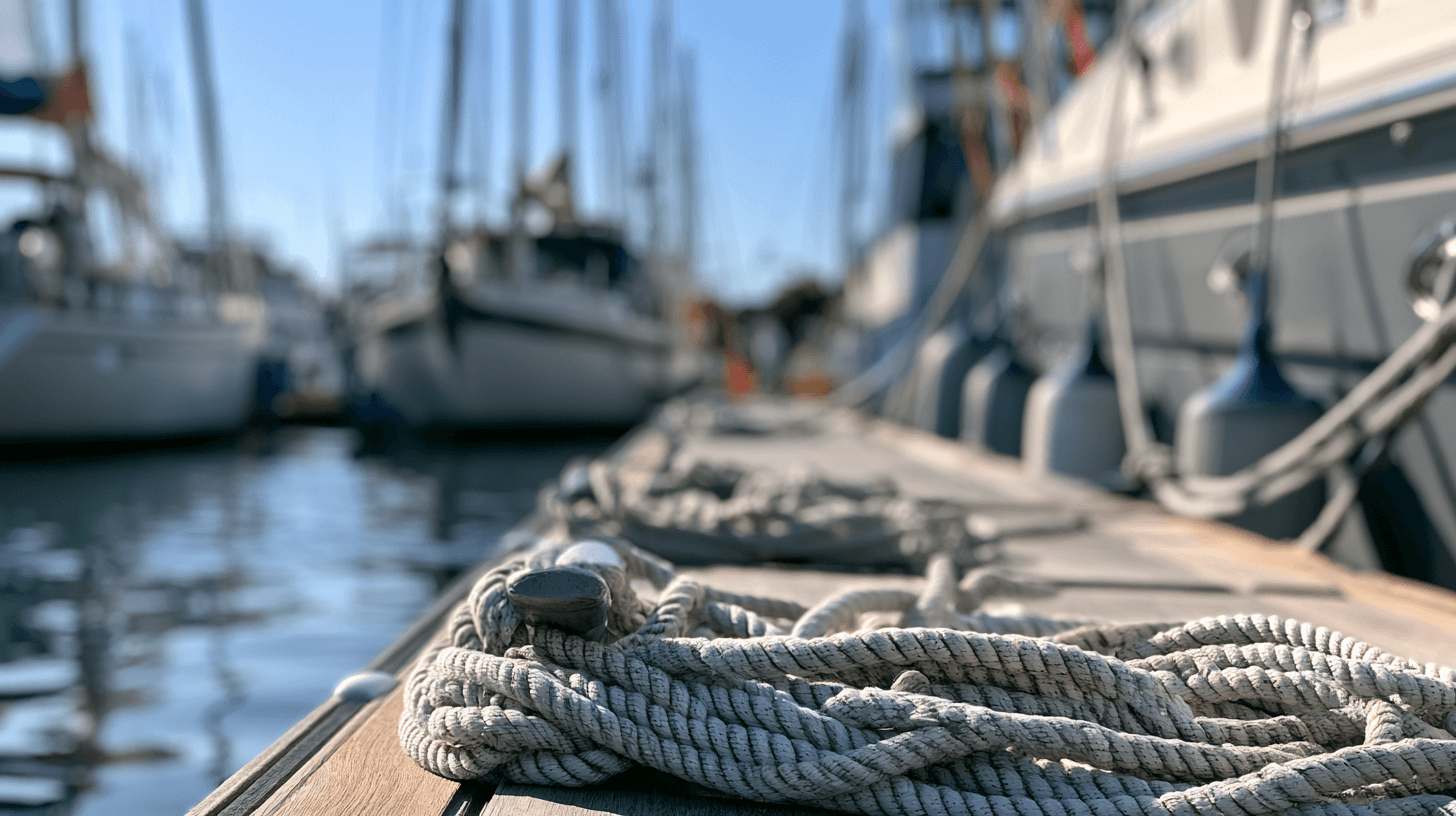
Somewhere in the mid-30s a threshold gets crossed. Below it, one person can run the helm and handle a line. Above it, you can’t. You can’t reach the midship cleat from the wheel. You can’t see the corner of the dock. You can’t step off. The boat now requires two people who each know what they’re doing, and it requires that on every single arrival, in front of whoever happens to be standing on the seawall.
Plenty of couples cross that line without ever discussing it. The captain keeps captaining the way he always has, the person on the bow is suddenly doing a job nobody taught them, and by the third weekend there’s yelling. That isn’t a relationship problem. It’s a training problem, and it has a fix. First Mate Coaching exists for exactly this crossing point, and so does an agreed set of hand signals, because voice is the first thing that fails at a dock.
The systems multiply faster than the length
The new boat almost certainly has a generator. Probably air conditioning. Maybe two engines where you had one, plus a windlass, a bow thruster, more through-hulls, a bigger house bank, and shore power that needs managing rather than plugging in.
Your pre-cruise routine changes shape along with all that. On a smaller boat it’s a glance in the bilge and a look at the gauges. On this one it’s an actual engine room check: strainers, fluid levels, leaks, blowers, done the same way every time, because there’s more that can fail and less of it visible from the helm.
One note on thrusters, since they usually come with the move-up. A thruster is an assist, not a skill. It’s weakest in strong wind, which is when you want it most, and it will pick a bad day to quit. Learn to put the boat where you want her without touching the joystick. Then use the joystick, and enjoy it.
Your insurance carrier has opinions about this
Here’s the part that catches buyers flat-footed, usually after the offer is already in.
Underwriters treat a jump in length as a risk event. Gallagher Charter Lakes writes that many companies cap the jump at ten to fifteen feet and want two to four years of experience on a vessel within that range of the one you’re buying. The Boat Galley reports that underwriters have a name for the practice: the 10-foot rule, meaning they want time on a boat no more than ten feet shorter than the one you’re insuring.
When you fall outside it, the common remedy is a captain’s warranty — a condition written into the policy saying you don’t run the boat alone until a licensed captain has trained you for a set number of hours and signed off. That used to mean twenty or thirty hours. The Boat Galley reports that carriers still writing it now often require up to a hundred.
None of this is a reason not to move up. It’s a reason to make the call early. Ask the questions before the offer, not after the survey comes back clean and you’re emotionally committed to a boat you may not be able to insure the way you assumed. If the policy comes back with a captain’s warranty anyway, that’s the insurance check ride and sign-off work I do, on your own boat.
What the extra length actually buys you
It would be easy to read all of that as an argument for staying put. It isn’t.
A bigger boat is better in a Lake St. Clair chop, and that shallow lake serves up more chop than its size suggests. She’s better on the long runs, up the St. Clair River into Lake Huron or a week in the North Channel. She’s better when there are six people aboard and two of them want to go to bed. Those are real reasons, and they’re why most move-ups turn out to be the right call.
The people who struggle aren’t the ones who bought too much boat. They’re the ones who bought the right boat and assumed the skills came with it.
The season that decides it
The first season on a bigger boat sets the tone for the whole time you own her. Handled well, the boat gets smaller in your head by July. Handled badly, you start finding reasons not to take her out, and by the second summer she’s a slip ornament with a payment.
Two things make the difference. First, get the hours at idle speed before you need them, in your own water, with the person who’ll be standing on your bow. Second, get somebody aboard who has run boats this size and can tell you what she’s telling you. That’s what Captain’s Coaching is — five modules on your boat, in your home waters, working through docking, running, anchoring, trip planning, and log-keeping at the size you actually bought.
If the boat is coming from out of market, there’s a version that does both at once. An owner-assisted delivery brings her home and turns the trip into the longest coaching session you’ll ever get.
I’ll say the thing that probably costs me work: a fair number of people who think they need more boat need more time on the one they have. But when the move-up is right, and it usually is, the difference between a good first season and a rough one has almost nothing to do with the boat. It comes down to whether anybody showed you how to run her.
If you’ve got a bigger boat under contract or you’re circling one, that’s worth a conversation before the season starts — including who brings her home, if you’d rather have a professional delivery captain make the first trip.
Keep Reading


FROM THE HELM
New articles, straight to your inbox.
A short note whenever a new piece goes up — seamanship, ownership, and lessons from the water. No spam, unsubscribe anytime.