If Your Boat Runs Aground: What to Do First and What to Check After
A 60-foot Viking, a passing barge and a soft bank north of Demopolis. How the owners got her off, and the order I work through when a boat runs aground.

Captain Tom Ketelhut
“We have run aground.”
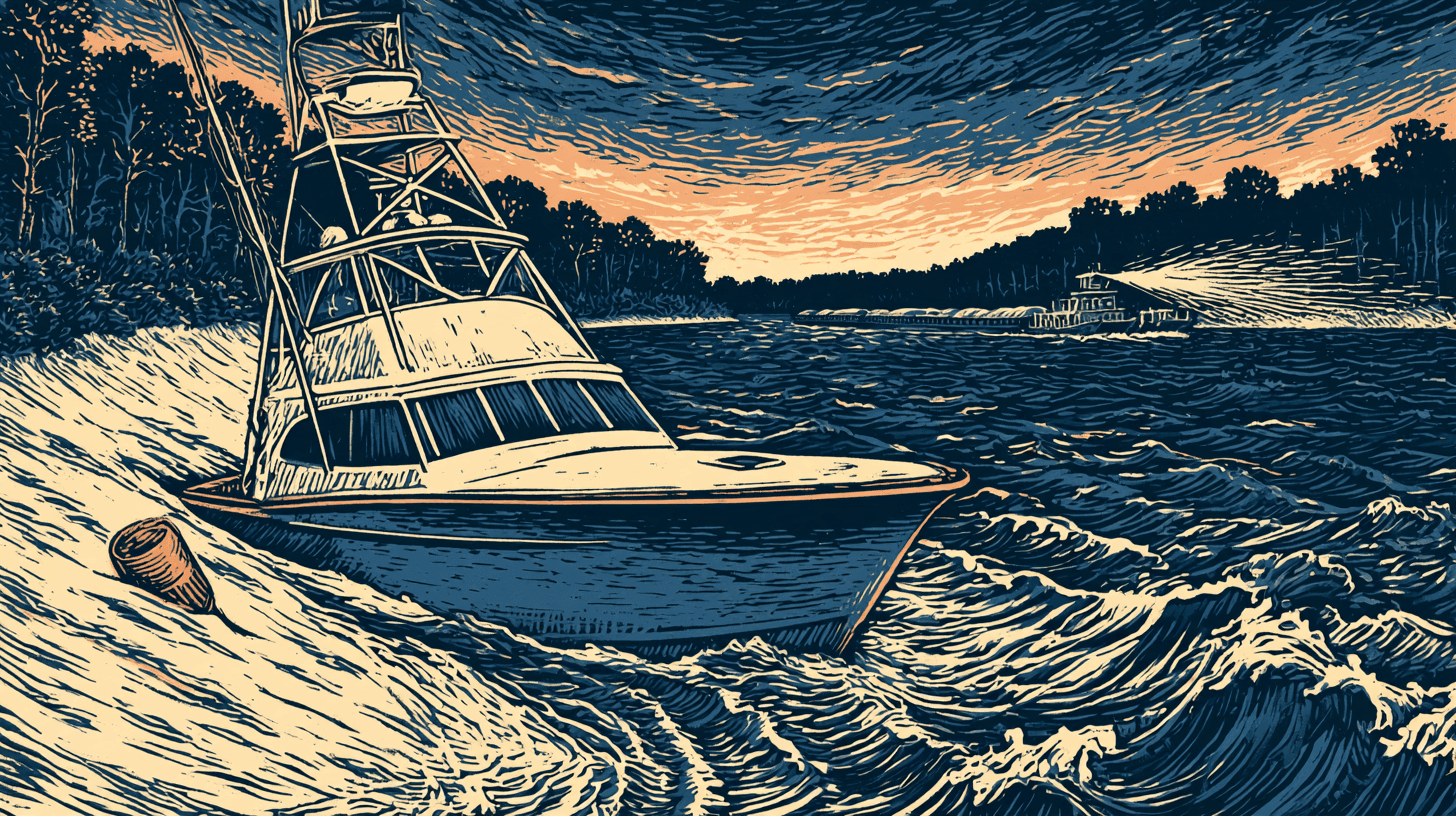
Four words every captain takes seriously. They came over the phone a couple of hours after dinner, from a cruising couple aboard a 60-foot Viking Cockpit Sport Yacht north of Demopolis, Alabama, on the Great Loop. The boat was sitting on the shallow bank at the edge of the channel. Daylight was fading, and the river was still moving.
If your boat runs aground, the first few minutes decide how it ends: backing off with a story to tell, or paying for a haul-out and a survey. Here’s how that night went, and the order I work through on any call like it.
Aground right now? The short version.
Throttles to neutral. Don’t try to power your way off.
Make sure everyone’s OK. Life jackets on if there’s any chance you’re holed.
Check the bilge. If water’s coming in, get help on the way before anything else.
Shut down the generator and your main engine(s).
Losing the light? Anchor light on, and tell commercial traffic on channel 13 that you’re aground. If your vessel exceeds 12 meters LOA then you should also display red over red lights if possible.
Find the deep water, and find out what you’re sitting on.
Read the current and the wind, then decide: work her off, or call a tow.
Once you’re off, check every system before you run on.
Stop making it worse
The instinct is to throw it in reverse and pour on the throttle. That’s how a soft grounding turns into a damaged boat. On an inboard, the props, shafts and rudders hang under the hull, and you can’t tilt them out of the way like an outboard or a sterndrive. Power hard and you risk chewing up the running gear and pulling mud and sand through the raw-water intakes. Pull the throttles to idle, move transmission to neutral and shut down the engine(s).
Then the crew. A sudden stop throws people around, so make sure nobody’s hurt. Once everyone’s accounted for, look in the bilge. If water’s coming in, getting off is no longer the goal. A holed boat on the bottom can’t sink any farther. Pull her into deep water and she can. Get help on the way first, on channel 16, the way I lay it out in the First Mate’s emergency playbook.
Next, shut down the generator. It draws cooling water through its own intake, and in the shallows it can pull mud and sand straight through it. That’s one reason the engine room walk-through comes first with every Captain’s Coaching client: you should know where every intake sits, and what it feeds, before you need to.
If the light’s going, get your anchor light on. At 12 meters (about 39 feet) and up, the Navigation Rules also call for two all-round red lights, one above the other, if it’s practicable. Then call anything commercial that’s coming. Towboats 26 feet and longer are required to monitor channel 13, so tell them you’re aground.
Separate fact from fear
On a call like that, the first job is to listen, separate fact from fear, and work out the safest next move. Here’s what they told me: “We passed a barge, moved slightly outside the channel, and put the boat aground.” The Viking was stuck fast and going nowhere.
Before anyone moved a throttle or handled a line, we needed facts. These are the questions I’d ask anyone sitting on a bank:
Where’s the deep water? Your depth sounder only reads what’s under the transducer. The chartplotter track shows the water you just came through, and the chart shows which side the channel is on.
What are you sitting on? Mud and sand usually let a boat go. On rock, every time she moves she may be doing more damage.
What’s the water doing? On a river it’s current, and on salt water it’s the tide. The Great Lakes are considered non-tidal, but wind moves the water. NOAA notes that Lake Erie is known for seiches, especially when strong winds blow from the southwest to the northeast and push the water from one end of the lake to the other. Aground at the west end with that wind building, waiting won’t float you off. The water is leaving.
Which engines can you run without pulling mud into them?
How much daylight is left, what’s the weather doing, and is anything big coming down the channel?
The Viking’s answers were workable. The starboard side was pinned in shallow water. The port side still had enough depth to run the port engine. The current ran downriver against the stern. One engine, one side with deeper water, and a current that could work for us or against us.
Who pulls you off
You have three choices: work her off yourself, call a professional, or take a line from the boat that stopped to help.
Depending on the circumstances, a professional tow can quickly become the safest decision. It’s the call to make if you’re on rock, taking on water, getting pushed farther on, or not sure where the deep water is.
A towing membership with TowBoatUS or Sea Tow covers a soft ungrounding within the plan’s terms. A boat in real peril is a different job. That work can be billed as salvage, outside the membership, and it usually ends up on your hull policy. Ask the operator whether it’s a tow or salvage before a line comes aboard, and find out how your policy handles salvage long before you need it.
Taking a line from another recreational boater? Not my recommendation. A heavily loaded towline can part without warning and turn a recovery into a far more dangerous emergency. Assistance towing is its own endorsement on a captain’s license, and it’s on both of mine. A line under that kind of load is no job for a well-meaning stranger with a dock line.
How we got the Viking off
Because the bottom was soft, we chose a controlled recovery. I was on the phone. The owners did every bit of the work.
First, they shut down both main engines and then the generator. Once the deep water on the port side was clearly identified, the port engine was re-started. Then the helm went hard to starboard, toward the bank, and the port engine went in and out of forward gear in short pulses: enough rotational inertia from the propeller and thrust to push water across the rudder, not enough to drive the bow farther up the bank. With prop wash working the rudder and the current pushing on the stern, she started to answer. Slowly, the stern walked to port. Then it reached deeper water. Once the stern of the vessel had reached the deeper water, they restarted the starboard engine, and the Viking backed into the marked channel and about 18 feet of water.
Anyone who has sprung a stern off a dock will recognize the move: bow spring on, wheel toward the dock, forward at idle, and the stern walks out into open water. That night the bank held her the way the spring does. The stern drives the boat, not the bow, even with one side of her in the mud.
A few rules carry over to any self-recovery:
Use what’s working for you: the engine in deep water, the rudder, the current, the wind.
Short pulses in gear, not steady throttle. Steady power digs you in.
Back out the way you came once your running gear is in deep water. That water was deep enough a minute ago.
If a few honest tries don’t move her, stop and call for a tow.
Before you run on
Clearing the bank was only the first win. In clear water, the owners ran each engine on its own, in forward and reverse, while they listened and felt for vibration or drivetrain noise. They watched engine and transmission temperatures and pressures against the normal readings in their log. Any abnormal sound, vibration, temperature, pressure, leak or change in handling would have meant limping to the nearest port in safe mode and having a professional look her over.
That’s the check I’d want after any grounding, however gentle:
Bilge, shaft seals and rudder ports: any new water?
Raw-water strainers: mud, sand or weed in the baskets?
Each engine alone, forward and reverse: start at idle and step the rpm up, backing off at the first new vibration. That’s how a bent prop or shaft tells on itself.
Temperatures and pressures against your normal numbers.
Steering: does she track straight and answer the helm the way she did this morning?

You can’t spot abnormal if you never wrote down normal. If your log doesn’t have your temperatures and pressures at your usual cruising rpm, start writing them down on your next run.
If anything’s off, get her to the nearest port and have her looked at, by a diver or on a haul-out, before the next long run. If the damage comes to $2,000 or more, federal rules require the operator to file a boating accident report with the state within 10 days, and some states set the bar lower. Call your insurance agent before the yard starts work.
On the Viking, everything read normal. The owners ran on to the next anchorage and turned a tense night on the river into a lesson they can pass along to other Loopers.
How it happened, and how to avoid running aground
Read their first sentence again: “We passed a barge, moved slightly outside the channel.” Passing a barge tow means sharing the channel with it, and slightly outside was far enough to find the bottom.

On the radio it sounds simple: “I’ll give you the deep water.” The catch is that the deep water you just gave away was yours too. Here’s how to make room without running out of it:
Talk first. Call the towboat on 13 before the pass and agree on a side.
Pick the spot early. At 60 feet, a boat like the Viking is under 20 meters, and Rule 9 of the Navigation Rules says it can’t impede a vessel that can only safely navigate inside a narrow channel. So slow down and pick where the meeting happens while you still have room.
Watch the water as you move over, not after. Sounder, plotter and marks, the whole time.
None of this is special to Alabama. At home it’s a laker, and the same squeeze plays out on the Detroit River. In the St. Clair Flats, rock and riprap sit just under the surface along some channel edges. On Lake St. Clair, outside the shipping channel, you can go from 27 feet to 2 in a few boat lengths. Know before you go: learn where the edges are before you have to move over for anybody.
Why every client has my number
Preparation and patience got the Viking off that bank. The couple had spent four days aboard with me at Jefferson Beach before they left, and on day three, in 15 to 20 knots, they practiced holding her bow to a wall and walking the stern. Same idea, different wall.
Every client has my cell number for nights like that one. If I’m underway or with another client when it rings, I call back as soon as I can, and always the same day. If you’re heading south this winter or getting ready for the Loop, a quick call is the place to start.
When it was over, the owner told me, “You have to put this on the site.” He wanted the next boat to have it. I hope you never have to say those four words. If you do, take the next ten minutes in order.
WRITTEN BY
Captain Tom Ketelhut
USCG Master since 2009: 100 GT Great Lakes, 50 GT Near Coastal. Home port Grosse Ile, Michigan; deliveries and coaching from Lake Erie to Lake Huron, and in Florida.
WHERE TO NEXT
Keep going
More from Great Loop
More on Seamanship · next unread

Boating in Florida vs. the Great Lakes: What Changes at the Helm
Read Next →

Leaving the Dock in Wind: The Line Everybody Casts Off First
Read Next →

Raft-Up Etiquette: How Not to Be That Boat in the Anchorage
Read Next →

Four Ways to Have a Safe Fourth of July on the Water
Read Next →

Right of Way on the Great Lakes: Who Yields and When
Read Next →

What Lake Erie Asks of Boat Owners
Read Next →
THE SERVICE THAT HELPS
Private lessons aboard your own boat: docking, handling, anchoring and trip planning.